
Commercial & Industrial Steam Cleaners | Pure Steam Cleaners.uk


Last Updated: November 10, 2026
Quick Summary
Effective steam cleaner maintenance means draining the water tank after every shift, clearing the nozzle and wiping the gun, then descaling the boiler on a schedule set by your water hardness. Keep a dated maintenance log for every machine and complete a weekly safety inspection.
- Drain the tank while warm and release pressure through the steam gun first.
- Clear the nozzle jet with a fine pin after every shift to prevent weak steam.
- In hard water areas, descale monthly during heavy use rather than annually.
- Flush until the run-off runs clear and odour-free, usually two or three tank volumes.
- Record pressure at cut-off after every descale and compare it with the last logged reading.
Table of Contents
- Daily and Post-Use Steam Cleaner Maintenance Routines
- The Industrial Steam Cleaner Descaling Procedure
- Building a Preventive Maintenance Schedule for Cleaning Equipment
- Commercial Steam Cleaner Troubleshooting: Pressure, Blockages and Leaks
- Your Steam Cleaner Safety Inspection Checklist
- Boiler Care, Planned Servicing and Storage Between Jobs
- Choosing a Steam Cleaner That Is Easier to Maintain
- Frequently Asked Questions
Daily and Post-Use Steam Cleaner Maintenance Routines
A commercial steam cleaner maintenance guide is only as good as the habits it builds into a shift, and the most important habit costs five minutes. Empty the water tank and remove any remaining water after every use, as Intersteam’s commercial steam cleaner training guidance recommends, because standing water is where mineral deposits begin. At Pure Steam Cleaners, we tell every new operator the same thing: the machine you drain properly tonight is the machine that fires first time tomorrow.
Emptying the Water Tank After Every Shift
Drain the tank while it is still warm, never pressurised. Release pressure through the steam gun first, then open the drain and tip away the remainder.
Wipe the tank interior with a soft cloth and leave the filler cap off so moisture can escape. In hard water areas, a weekly rinse with deionised water slows mineral buildup between full descaling cycles.
Caring for the Steam Hose, Steam Gun and Nozzles
Coil the steam hose loosely rather than wrapping it tight around the gun, and check the couplings for wear each week.
Wipe the steam gun down and inspect the O-rings. If a hose is cracked or kinked beyond use, a compatible 3m steam only hose restores the machine without a service call.


The Industrial Steam Cleaner Descaling Procedure
Descaling a manually descaled boiler is a multi-step cycle: cool and drain the machine, add a descaling solution to the tank, heat and circulate it through the boiler, flush with clean water until the run-off is clear, then refill and test steam output.
- Switch off, release pressure through the steam gun and let the boiler cool completely. Never open a pressurised boiler.
- Drain the tank and remove loose debris from the filler neck. A soft bottle brush reaches the level probes that a cloth misses.
- Add descaler at the dilution on the label, never neat. Check the descaler’s label and safety data sheet for the correct dilution before you mix.
- Heat the machine and draw steam through the gun until the solution has circulated. On a manual-fill boiler, allow the solution to dwell for the contact time stated on the label, typically 15 to 30 minutes, before flushing.
- Flush with clean water, refill, and run a test burst to confirm pressure. Flush until the run-off runs clear and odour-free; two or three tank volumes is normal.
How often you descale depends on water hardness and heavy-duty usage. A soft water site may stretch to quarterly; a hard water site running daily shifts needs it far more often.
Why Hard Water Areas Need a Tighter Descaling Cycle
Hard water is the single biggest driver of component wear in steam equipment, and a fixed annual descale will not protect a machine fed on chalky supply. Our guide to preventing limescale in commercial steam cleaners covers the between-cycle habits that keep buildup down.
In hard water areas, weak steam at the gun can be caused by scale on the element or a blocked nozzle, so check the nozzle before assuming the boiler needs another descaling cycle.
Descaling Chemicals and Their Environmental Impact
The environmental impact of descaling chemicals depends largely on how they are handled and disposed of. Never pour used descaling solution down a surface water drain.
Watch out: mixing an acid descaler with a chlorine-based sanitiser in the same tank produces chlorine gas (Disinfectants in the food and drink industry).
Choosing a machine that descales itself removes most of this handling entirely. Self-descaling boilers reduce both chemical use and the labour hours tied up in manual cycles, and they remove the disposal question because the flush water is dilute and predictable.
Verifying the Descale Has Worked
A descale is only finished when the machine proves it. After the final flush, run a full heat-up and record the pressure at cut-off, then draw steam continuously for two minutes and watch the gauge. A clean boiler holds pressure steadily; a scaled one drifts down as the element struggles. Compare the reading against the machine’s commissioning figure or the last logged reading.
Building a Preventive Maintenance Schedule for Cleaning Equipment
A preventative maintenance schedule for cleaning equipment turns maintenance from a reaction into a routine. Set daily, weekly, monthly and annual tasks, assign each to a named person, and record completion. Machines that follow a written schedule stay in service longer and fail less often during busy periods.
| Frequency | Task | Who | Record |
|---|---|---|---|
| Every shift | Drain tank, clear nozzle, wipe gun | Operator | Initial and time on shift sheet |
| Weekly | Inspect hose, seals and O-rings; safety checklist | Supervisor | Signed weekly sheet |
| Monthly | Check safety valve and pressure switch; descale in hard water areas | Maintenance | Log entry with pressure reading |
| Quarterly | Full descale and performance test | Engineer | Service report filed with machine |
| Annually | Planned service and portable appliance inspection and testing | Competent person | Certificate and service record |
Maintenance Logs and Tracking Templates
A maintenance log is a dated record of every task, fault and repair, and it is the document that proves planned servicing has happened. Keep one sheet per machine with columns for date, task, operator, parts used and steam output reading. It takes a minute to complete and settles most warranty questions on the spot.
A workable log has five fields per entry: date and shift, task completed, operator initials, pressure reading at cut-off, and any fault raised. Keep the log with the machine rather than in an office folder, a log that lives on the trolley gets filled in, a log that lives in a drawer does not. For multi-site operations, a single-page template per machine, printed and clipped to the machine’s folder, is more reliable than a shared spreadsheet that nobody updates mid-shift.
- Date and shift recorded
- Tank drained and flushed
- Nozzle cleared, hose inspected
Why the Log Matters Beyond Maintenance
The log is also the evidence trail for insurance and for any warranty claim. If a boiler fails at eighteen months and the manufacturer asks whether the machine was descaled to schedule, the log answers the question.
Watch out: a log that is filled in retrospectively in one sitting is worse than no log at all, because it creates a false record.
Assigning Responsibility So the Schedule Holds
A schedule fails when every task belongs to everyone. Name a single responsible person for each frequency band: the shift supervisor owns the daily and weekly tasks, the maintenance lead owns the monthly checks, and the engineer owns the quarterly and annual service. The operator’s job is to complete the daily tasks and report faults, not to decide whether a fault is serious.
Commercial Steam Cleaner Troubleshooting: Pressure, Blockages and Leaks
Commercial steam cleaner troubleshooting starts with three checks: is there pressure, is steam reaching the gun, and is water escaping anywhere it should not. Low pressure usually traces to scale on the element or a failing pressure switch. Weak steam at the nozzle points to a blockage. Puddles under the machine mean a worn seal or gasket.
Work through the simple causes first. A blocked nozzle, a kinked hose or a loose coupling accounts for most complaints, and each is a two-minute fix. Persistent low boiler pressure after descaling is a job for an engineer, because the safety valve and pressure switch are not user-serviceable parts.
Post-Repair Performance Testing
After any repair, run a full heat-up, record the pressure at cut-off, draw steam continuously for several minutes and check the output holds steady. Log the readings against the pre-fault figures.
Your Steam Cleaner Safety Inspection Checklist
The steam cleaner safety inspection checklist covers electrical safety, pressure integrity and physical condition. Complete it before the first shift of each week and after any repair.
- Plug, cable and RCD tested, no scorching
- Safety valve free of scale and operating
- Boiler pressure settles at the correct cut-off
Electrical safety deserves particular attention in wet environments. Any portable appliance used commercially should be inspected and tested on a schedule by a competent person, and the results recorded alongside the maintenance log.
Boiler Care, Planned Servicing and Storage Between Jobs
Regular boiler care helps a machine last longer, while a boiler left full of hard water between jobs will scale regardless of build quality.
Planned servicing should sit on the calendar, not wait for a breakdown. Book an annual service, keep spare seals and gaskets on the shelf, and store the machine drained, dry and with the hose coiled loosely.
Choosing a Steam Cleaner That Is Easier to Maintain
The best maintenance routine is the one the machine makes easy, and self-descaling technology is the single biggest change here. A self-descaling boiler flushes scale automatically, so the manual descaling cycle becomes a rare event rather than a monthly chore.
Our self-descaling boilers carry a three-year boiler guarantee and are backed by 30 years of experience. The commercial steam cleaner range includes the v6 Commercial Steam Vacuum Cleaner at £1,495.00 and the v6-DT Commercial Steam Cleaner With Vacuum and Detergent at £1,745.00, both with 6 bar steam pressure and a steam volume of 43 g/min.
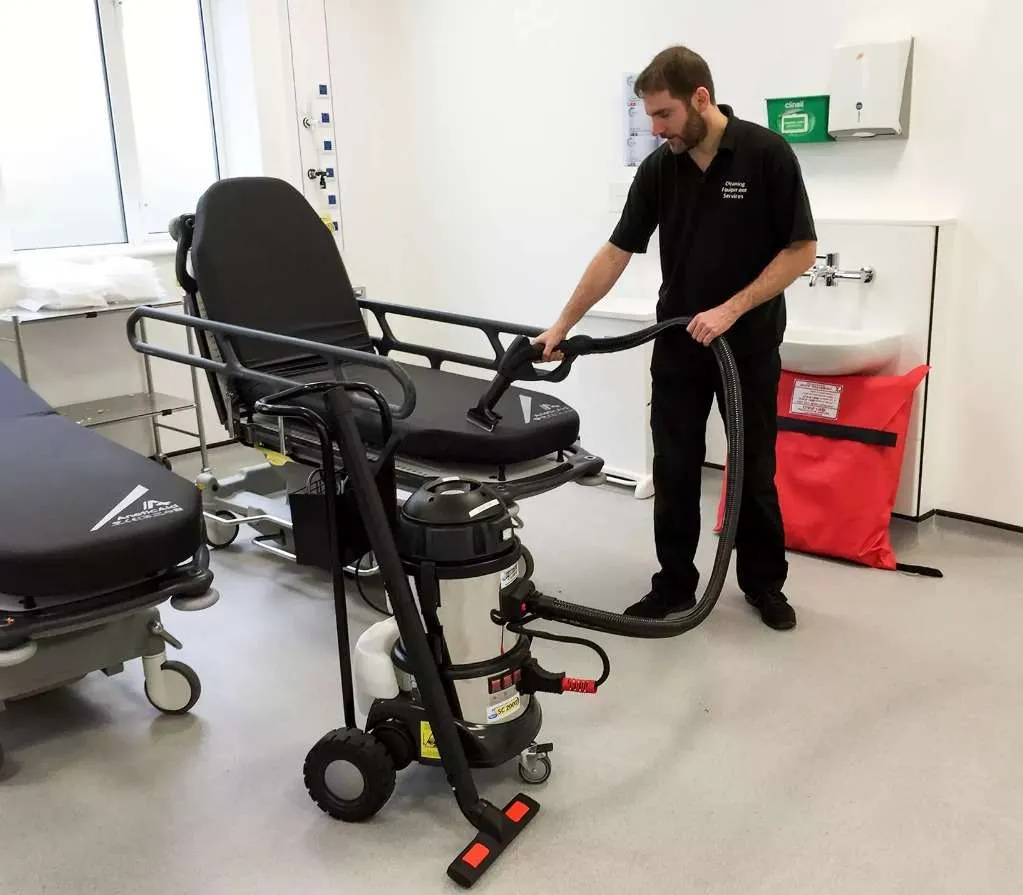
Keeping a commercial steam cleaner running reliably comes down to a drained tank, a clear nozzle and a descaling cycle you actually follow.
Frequently Asked Questions
How often should commercial steam cleaners be descaled?
There is no single interval that fits every site. Manufacturer guidance says to descale regularly but rarely fixes a number, because water hardness, daily running hours and steam output all change how quickly mineral deposits form. Sites in hard water areas should inspect the boiler and level probes more often and descale sooner than soft water sites. Record each descale in your maintenance log so you can spot the pattern and set an interval based on your own machine, not a generic figure.
What are the daily maintenance requirements for industrial steam equipment?
Empty the water tank and remove any remaining water after each use, as recommended in commercial steam cleaner training guidance. Wipe down the steam gun, check the nozzle for blockage and inspect the steam hose for kinks or splits. Coil the hose without tight bends and store the machine dry. A two-minute end-of-shift routine helps reduce mineral buildup and nozzle blockage.
Why is regular boiler maintenance critical for steam cleaners?
The boiler is where mineral deposits and calcium deposits collect, and those deposits reduce steam output, strain the heating elements and raise component wear. Left alone, limescale can build up on the heating element and affect steam output. Regular boiler care, including descaling and checking level probes and the safety valve, is recommended for consistent operation.
How do I troubleshoot common steam pressure issues?
Start with the simple causes. Check the water level and level probes, confirm the nozzle and steam gun are not blocked, and look for kinks in the steam hose. If pressure still drops, inspect the seals and gaskets for wear and check the pressure switch. Never open the boiler or adjust the safety valve yourself. If the fault persists after these checks, book planned servicing rather than running the machine harder, which accelerates component wear.
What safety checks are required for commercial steam cleaning machines?
A practical steam cleaner safety inspection checklist covers the plug and cable for damage, the safety valve and boiler pressure gauge, the pressure switch, hose condition and seals and gaskets. Confirm the machine has cooled before any inspection and that electrical safety testing is up to date. Record every check with a date and initials in your maintenance log. This documentation supports your hygiene and health and safety records and gives inspectors and insurers a clear audit trail.

