
Commercial & Industrial Steam Cleaners | Pure Steam Cleaners.uk

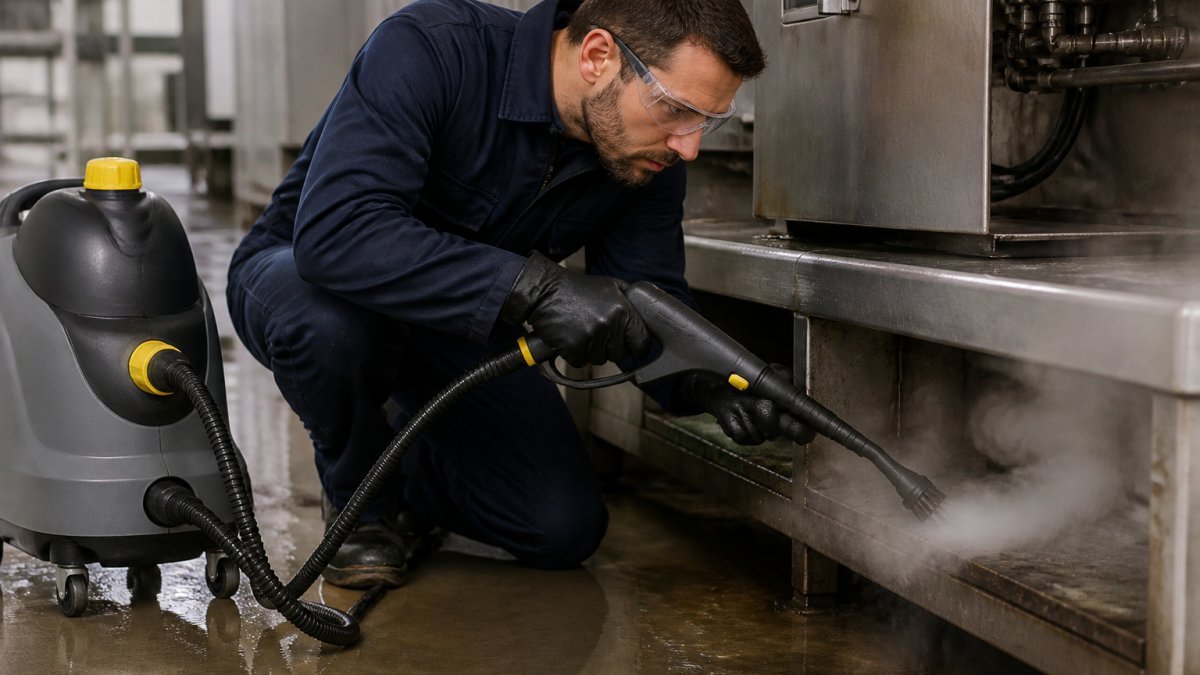
Table of Contents
- How to Maintain Industrial Steam Cleaners: What You’ll Need
- Daily Maintenance Checklist for Steam Cleaners
- Step 1: Empty and Rinse the Boiler Once a Month
- Step 2: Follow a Proper Industrial Steam Cleaner Descaling Procedure
- Step 3: Check Hoses, Seals and O-Rings for Wear
- Step 4: Is Steam Cleaning Safe for Electrical Panels?
- Common Mistakes and Troubleshooting
- Conclusion: Build Maintenance into the Working Week
- Frequently Asked Questions
Last Updated: October 9, 2026
How to Maintain Industrial Steam Cleaners: What You’ll Need
Industrial steam cleaners are pressurised machines that turn water into dry steam for chemical-free degreasing and sanitation. Keeping one running for years comes down to a simple routine, and this guide from Pure Steam Cleaners walks you through exactly how to maintain industrial steam cleaners week by week.

Below, we’ll show you the tools to keep on site, a daily checklist, and the four maintenance steps that matter most. We’ll also cover what most guides get wrong about descaling and electrical safety.
Tools and Consumables to Keep on Site
You do not need a workshop full of kit. A basic maintenance shelf covers almost everything:
- Spare O-ring kit for steam tools
- Soft cloths and a small brush
- A descaling solution approved for your boiler type
- Food-safe silicone grease
- A torch for checking seals
- A simple logbook or wall chart
Keep these within reach of the machine. If a seal fails mid-shift, you want the replacement in the same room, not in a storeroom across the site.
Daily Maintenance Checklist for Steam Cleaners
A daily maintenance checklist for steam cleaners takes five minutes at each end of the day. That small habit prevents most of the costly repairs we hear about from facility teams.
Before the First Job of the Day
- Check the water container is full and clean
- Inspect the hose for kinks or cracks
- Test the steam trigger for a steady flow
- Confirm the safety cap is tight
- Look for water pooling under the machine
After the Last Job of the Day
- Release pressure fully before opening anything
- Empty the water container and rinse it
- Wipe down the wand and brushes
- Coil the hose without sharp bends
- Note anything unusual in the logbook
Log the steam pressure reading at the end of each day. A slow drop over several weeks tells you a seal is going before it fails completely.
Step 1: Empty and Rinse the Boiler Once a Month
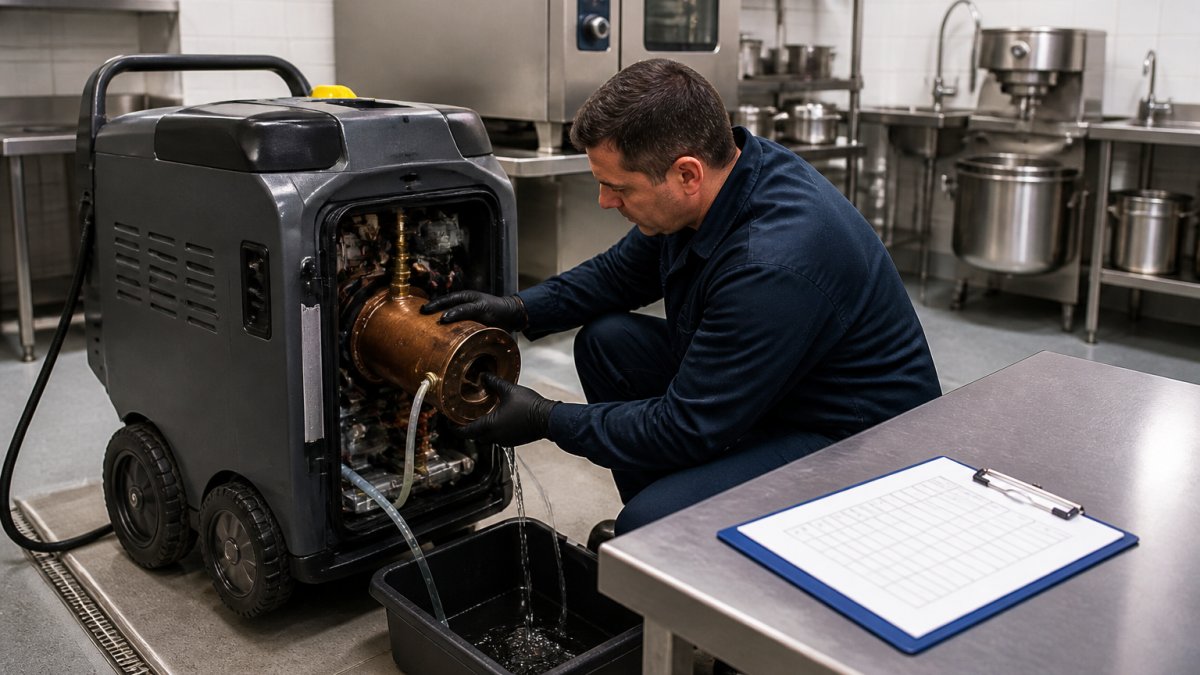
Emptying and rinsing the boiler monthly is the single most important habit for long machine life. It takes ten minutes and stops scale from hardening inside the tank.
Here is how to do it:
- Let the machine cool and release all pressure
- Open the drain and empty the boiler fully
- Rinse with clean water until it runs clear
- Refill with fresh water before the next job
The reason this matters is simple. Hard water leaves mineral deposits behind every time you steam. Left alone, those deposits bake onto the heating elements.
Some boilers handle this far better than others. Our machines use copper boilers with external heating elements, which means limescale does not collect on the elements themselves. Empty and rinse once a month and you should have no scale problems.
A Water UK guide to hard water areas explains why some regions see far more scale than others.
Step 2: Follow a Proper Industrial Steam Cleaner Descaling Procedure
An industrial steam cleaner descaling procedure should only be needed if scale has already built up. On a well-maintained machine, monthly rinsing keeps it away.
If you do need to descale, follow this order:
- Mix descaler to the maker’s stated ratio, never stronger
- Warm the boiler, then switch off and isolate
- Pour in the solution and leave it to work
- Drain, then flush with clean water twice
- Run a steam cycle and check the flow
Never descale a hot, pressurised boiler. Opening a live unit can release scalding steam and cause serious burns. Always cool, isolate, and release pressure first.
Step 3: Check Hoses, Seals and O-Rings for Wear
Hoses, seals and O-rings are the cheapest parts on the machine and the most common cause of lost steam pressure. Check them every month.
Run your hand along the hose and look for:
Pure i8 Heavy Duty Industrial Steam & Vacuum Cleaner →
- Cracks or soft spots near the couplings
- Flattened sections that restrict flow
- Loose fittings that weep when hot
- Brittle or flattened O-rings
Swap any worn O-ring straight away. HSE guidance on pressure systems is clear that pressurised equipment needs routine inspection, and seals are part of that check.
Most “weak steam” complaints trace back to a worn O-ring, not a failing boiler. Check the cheap parts first.
Step 4: Is Steam Cleaning Safe for Electrical Panels?
Steam cleaning is safe for electrical panels only when the power is fully isolated and the steam is dry, low-moisture vapour. Wet steam plus live circuits is a serious shock risk.
So the answer to “is steam cleaning safe for electrical panels” is yes, with conditions:
- Isolate and lock off the supply first
- Use dry steam, not a wet jet
- Keep the nozzle moving, never hold it still
- Let the panel dry fully before restoring power
- Never steam inside a live enclosure
Dry steam flashes off quickly and lifts grease without flooding the components. That is why it works well on switchgear, motors, and control cabinets when the procedure is followed properly.
Common Mistakes and Troubleshooting
The same handful of mistakes come up again and again. Avoid these and your machine will outlast its warranty by years.
- Using tap water in a hard water area without rinsing
- Over-tightening the safety cap and damaging the seal
- Storing the hose coiled tightly for months
- Skipping the logbook, so faults repeat
- Running the machine dry
Signs Your Machine Needs Attention
- Steam pressure drops during a job
- The boiler takes longer to heat
- Water spits from the nozzle instead of dry steam
- The machine cuts out mid-cycle
- Unusual noise from the pump
If you see two or more of these, stop and inspect before the next shift.
| Problem | Likely Cause | Fix |
|---|---|---|
| Weak steam | Worn O-ring or seal | Replace O-ring |
| Slow heating | Scale in boiler | Rinse and descale |
| Water spitting | Wet steam, overfilled | Drain and refill |
| Cuts out mid-job | Overheat or low water | Cool and top up |
| Loud pump noise | Air in the line | Bleed and check hose |
For machines that see heavy daily use, our Pure i8 Heavy Duty Industrial Steam & Vacuum Cleaner is built for exactly this kind of schedule, with a 10-litre reservoir and over three hours of continuous running.
Conclusion: Build Maintenance into the Working Week
The real challenge is not knowing what to do. It is finding ten minutes in a busy shift to actually do it. Teams that build maintenance into the working week spend far less on repairs and downtime than those who wait for a breakdown.
At Pure Steam Cleaners, our patented self-descaling boiler technology, copper boilers with external heating elements, and a 3-year boiler guarantee mean less time fighting scale and more time cleaning. We have spent 30 years supplying professional steam cleaning equipment across healthcare, manufacturing and hospitality.
Get started with Pure Steam Cleaners and keep your machines running at full pressure, year after year.
Frequently Asked Questions
How often should you descale an industrial steam cleaner?
It depends on your water hardness and how often the machine runs. In hard water areas, monthly boiler rinses are essential, and a full descale should be scheduled every three to six months. Machines with copper boilers and external heating elements, such as the Pure i8 and Pure i6-SV, resist limescale far better than internal-element designs. Watch for longer heat-up times, weaker steam volume or a boiler that needs topping up more often. These are the clearest signs that descaling is due, whichever schedule you follow.
What are the common signs that a steam cleaner needs maintenance?
The main warning signs are reduced steam pressure, longer heat-up times, visible scale around the boiler, dripping or stiff trigger valves, cracked seals, and a vacuum that has lost suction. Any of these points to a specific task: rinse the boiler, replace the O-rings, clear the vacuum filter, or book a service. Catching them early prevents a breakdown during a busy service period. Keep a simple log of pressure and heat-up times so you spot changes before they become failures.
Is steam cleaning safe for electrical panels?
Steam cleaning is safe for electrical panels only when the power is fully isolated and the panel is completely dry before it is re-energised. Dry steam with low moisture content is the correct method, and the machine should be held at a safe distance so steam does not force water into sealed components. Never steam a live panel, and never use a machine with a water spray or detergent feed on electrical equipment. If in doubt, treat the panel as out of bounds and clean around it instead.
What daily checks are required for industrial steam cleaners?
Before the first job, check the water level, inspect the hose and tools for damage, confirm the boiler reaches full pressure, and test the trigger and safety valve. After the last job, empty and rinse the boiler, drain the waste tank, wipe down the tools, and store the machine with the hose coiled loosely. Record anything unusual in a maintenance log. This five-minute routine is the single most effective way to extend the working life of commercial steam equipment.
