
Commercial & Industrial Steam Cleaners | Pure Steam Cleaners.uk


Last Updated: November 22, 2026
Quick Summary
To clean extraction fans safely, isolate and lock out the fan first, then wear protective gear. Remove the guard, degrease the blades, scrub gently with a non-abrasive brush, dry them fully and keep moisture away from the motor.
- Switch off the fan at its isolator and lock out the supply before starting
- Wear heat-resistant or grease-resistant gloves, goggles, a long-sleeved top and non-slip footwear
- Let the degreaser dwell for the time the label recommends before scrubbing
- Dry the blades fully before reassembling, since moisture attracts dust and grease
- Never spray water into the motor, terminal box or cable entry gland
Table of Contents
- Why Commercial Kitchen Extraction Fans Need Regular Cleaning
- Safety Equipment and Isolation Before You Start
- How to Clean Extractor Fan Blades Step by Step
- Commercial Extractor Fan Filter Cleaning
- Commercial Kitchen Extraction Cleaning Frequency
- Routine Commercial Extraction Fan Maintenance Checklist
- Booking Your Next Deep Clean and Keeping Records
- Frequently Asked Questions
Why Commercial Kitchen Extraction Fans Need Regular Cleaning
Grease builds up inside an extraction fan faster than most kitchen teams expect. A fan that looks fine from below can be heavily coated on its blades and housing. That grease is a fire risk, it slows airflow and it makes the whole kitchen harder to keep hygienic.
Clean extraction fans protect three things. They reduce fire risk, they keep air moving so the kitchen stays cooler and cleaner, and they help the kitchen meet its hygiene obligations. Dirty fans also work harder, which can shorten their life.
Watch out: grease that has hardened over several months is far harder to remove than fresh build-up. Waiting until the fan is visibly clogged usually means a longer, more expensive clean.
- Grease on blades and housing is a fire hazard
- Build-up reduces airflow and extraction performance
- Heavy grease makes the fan work harder and wear out sooner
- Regular cleaning is easier than a deep clean after neglect
Safety Equipment and Isolation Before You Start
Before anyone touches the fan, isolate it. Switch off the fan at its isolator, then lock out the supply so it cannot be restarted by someone else during the clean. Confirm the fan has stopped completely and that blades have stopped spinning before you put your hands near them.
Wear the right protection (Using personal protective equipment (PPE) to control risks at work: Selection and use). Use heat-resistant or grease-resistant gloves, safety goggles, and a long-sleeved top. Non-slip footwear matters too, because kitchen floors are often wet with grease or water. If you work from a ladder or platform, make sure it is stable and that someone else knows you are working up there.
Check the area around the fan. Cover food preparation surfaces, remove any loose items from the work area, and make sure the kitchen is not in use while you clean. Good ventilation helps when you use cleaning products.
Follow the operating and maintenance instructions supplied with your fan and your site’s own safety procedures. These come first, whatever this guide says.
How to Clean Extractor Fan Blades Step by Step
Start with the power off and isolated, as described above. Then work through the following stages. The order matters: loosening grease before scrubbing saves effort, and keeping moisture away from the motor prevents the most common cause of post-clean fan failure.
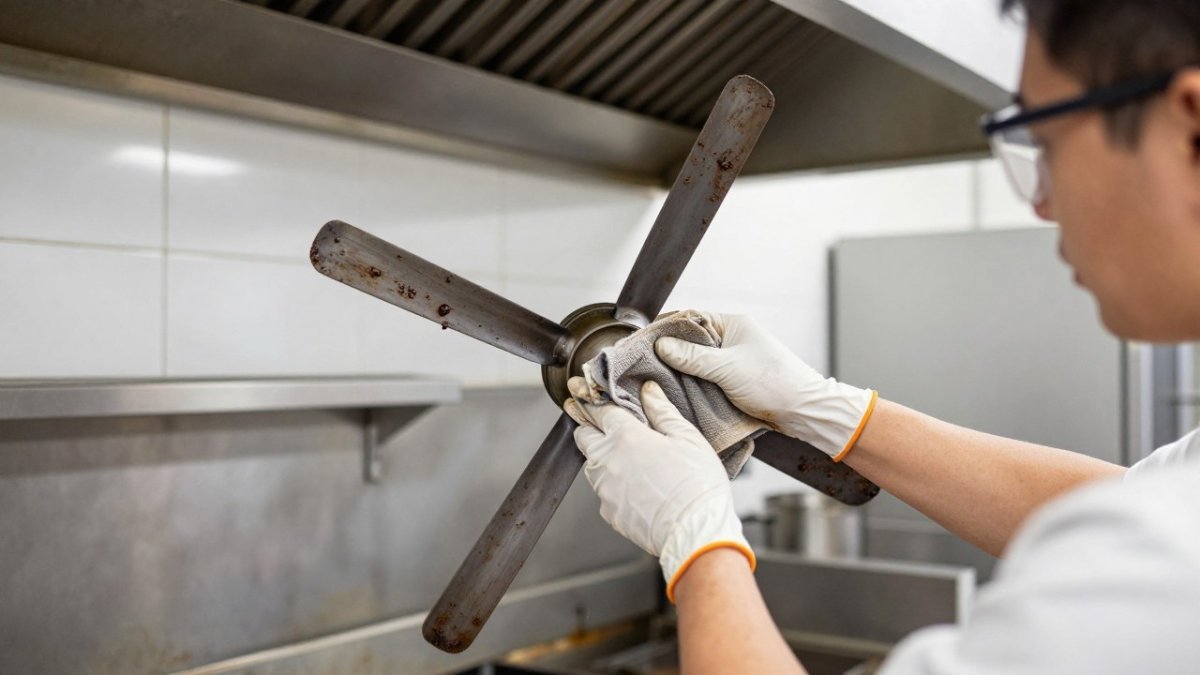
- Remove the fan cover or guard carefully, following the manufacturer’s guidance. Note how it fits before you take it off, because guards on commercial canopies are rarely interchangeable between models.
- Wipe off loose dust and surface grease with a dry cloth to reduce mess and stop grease being pushed further into the housing.
- Apply a suitable degreaser to the blades and housing, and let it sit for the time the product label recommends. Most degreasers need several minutes of dwell time to break down baked-on grease; scrubbing too early simply spreads it.
- Scrub stubborn grease with a stiff, non-abrasive brush, working from the edges inwards. A non-abrasive brush matters on aluminium and coated blades, which scratch easily and then trap grease faster.
- Wipe the blades clean with a damp cloth, then dry them fully before reassembling. Any residual moisture on the blades will attract dust and grease once the fan runs again.
- Reattach the guard and check it is secure before restoring power.
Matching the method to the surface. Bare aluminium blades respond well to an alkaline degreaser and a soft brush. Coated or painted blades need a gentler product to avoid dulling the finish. Stainless steel housings tolerate most kitchen degreasers but should be rinsed and dried to prevent water marks. If you are unsure what the blades are made of, check the fan’s data plate or manual before choosing a product.
Keeping the motor and wiring dry. A common mistake is spraying water directly into the motor housing or electrical parts. Keep moisture away from the motor and wiring, and wipe those areas with a barely damp cloth instead. Never direct a spray at the motor, the terminal box or the cable entry gland. If grease has reached the motor housing, wipe it off rather than washing it off. Keeping the motor dry also means preventing grease from building up around it, so regular attention to the hood filters helps limit what reaches the fan, as Titan Trucks Mfg notes.
Realistic expectations for heavy build-up. Grease that has hardened over several months will not come off in one pass. Expect to apply degreaser, dwell, scrub and wipe two or three times on heavily coated blades. If the grease has carbonised into a hard brown film, a second treatment after the first has dried is usually more effective than scrubbing harder on the first attempt.
For fans with heavy build-up, a steam cleaner can loosen grease without relying on harsh chemicals. Our Pure v6-T Commercial Steam and Vacuum Cleaner, priced at £1,595.00, has 6 bar steam pressure and a steam volume of 43 g/min, and is designed for cleaning grubby surfaces. Follow the manufacturer’s guidance for your fan model.
Watch out: if the fan blades are bent, cracked or badly corroded, cleaning will not restore performance and the fan should be assessed by a competent engineer before it is put back into service.
!Kitchen operative in protective gloves and goggles wiping greasy fan blades with a cloth in a commercial kitchen, extraction hood visible above a stainless steel cooking line
Commercial Extractor Fan Filter Cleaning
Filters catch most of the grease before it reaches the fan blades, so clean them on a regular schedule. Remove the filters carefully and check them for damage before cleaning.
Soak the filters in hot water with a suitable degreaser. Let them soak long enough to loosen the grease, then rinse them thoroughly. Dry them completely before refitting, because damp filters can cause problems in the extraction system.
Check the filters after cleaning. Replace any that are bent, torn or no longer clean properly. A filter that stays greasy after cleaning is often past its best.
The steps for cleaning filters, and the checks that follow, are summarised below.
| Stage | What to do | Time or frequency |
|---|---|---|
| Remove filters | Remove carefully and check for damage | Before cleaning |
| Soak | Hot water with a suitable degreaser | Long enough to loosen grease |
| Rinse | Rinse thoroughly | After soaking |
| Dry | Dry completely before refitting | Before refitting |
| Inspect | Replace bent, torn or still-greasy filters | After cleaning |
Commercial Kitchen Extraction Cleaning Frequency
There is no single schedule that suits every kitchen, but that does not mean the interval should be guesswork. Fast-food kitchens in particular can read our Steam Cleaning Tips for Fast-Food Kitchens for how often grease-heavy areas need attention. The right frequency depends on how much you cook, what you cook, how many hours the kitchen runs and how well the filters are maintained. A busy fryer station produces far more grease than a light-use kitchen, and a site running two shifts will load its extraction system far harder than one open for lunch only.
A practical framework. Most kitchens find the following pattern workable as a starting point, then adjust it to their own experience:
- Check filters weekly and clean or replace them as soon as they are visibly loading up.
- Wipe down fan blades and housings monthly as a routine, with a deeper clean whenever grease is visible on the blades. For context on how commercial kitchen equipment is typically cleaned, see Commercial Kitchens and Industrial Dry Steam Cleaners.
- Book a full deep clean of the extraction system at intervals set by your risk assessment, bringing it forward if the kitchen has changed its menu, increased covers or added frying capacity.
- Record every check and clean so you can see whether the interval is right. If filters are consistently heavily loaded at the weekly check, the interval is too long.
Why the fire-safety context matters. Extraction systems are a recognised fire risk in commercial kitchens because grease accumulates in ductwork and on fan surfaces, and a fire in the canopy or duct can spread quickly. The Regulatory Reform (Fire Safety) Order 2005 places a duty on the responsible person to manage fire risks in relevant premises, and extraction cleaning is part of that duty (The Regulatory Reform (Fire Safety) Order 2005). Your local fire and rescue service may also expect to see evidence of regular extraction cleaning during a fire safety audit. This is why records matter as much as the clean itself.
Signs the interval is too long. Watch for grease dripping from the canopy, a visible film on the fan blades after a recent clean, smoke or smells lingering in the kitchen, or the fan sounding louder or running hotter than usual. Any of these suggests the current schedule is not keeping pace with the load.
Watch out: if you only clean when the fan visibly struggles, the build-up is already well advanced, and the cost and disruption of the clean will be higher than if the schedule had been kept.
Routine Commercial Extraction Fan Maintenance Checklist
Use this checklist to keep the fan in good condition between deep cleans:
- Fan isolated and locked out before work starts
- Protective gloves, goggles and non-slip footwear worn
- Filters checked, cleaned or replaced
- Blades and housing wiped down for loose grease
- Motor and electrical parts kept dry
- Guard refitted and secure before power is restored
- Airflow checked after the clean
- Date and findings recorded
Booking Your Next Deep Clean and Keeping Records
Keep a simple record of every clean. Note the date, the work done, any faults you spotted and who did the work. This helps you spot patterns, such as a fan that fills with grease faster than the others.
If your team cannot clean the whole system safely in-house, book a professional deep clean. Pure Steam Cleaners offers steam cleaning equipment for demanding commercial environments, and you can browse our full range of commercial steam cleaners to see which machine suits your kitchen. For broader guidance on cleaning other commercial kitchen equipment, read our step-by-step guide to deep cleaning commercial kitchen equipment.
Frequently Asked Questions
How do you clean a commercial kitchen extraction fan?
Isolate the fan at the electrical supply first, then remove the filters and soak them in hot water with a suitable degreaser. Wipe the fan housing and blades with a cloth and degreaser, working from the cleanest areas to the most heavily soiled. Rinse away residue, dry all components fully and reassemble before restoring power. For fans that are hard to access or heavily contaminated, a specialist contractor is the safer choice, as they carry the right equipment and insurance for working on ductwork and roof-mounted units.
How often should commercial kitchen extraction fans be cleaned?
Cleaning frequency depends on how much your kitchen cooks and what type of food you prepare. Busy frying or grilling operations generate heavier grease and need more frequent attention than a light-use café. Filters should be checked and cleaned at least weekly in most busy kitchens, with the fan and extraction system deep cleaned on a schedule set by a professional assessment. Keep a written log so you can show inspectors and insurers that the work is being done.
Can you clean an extraction fan without removing it?
Some surfaces of an extraction fan can be cleaned in place once the power is isolated, including the outer housing, accessible blades and the filter housing. However, full cleaning of the fan motor, internal ductwork and hard-to-reach blades usually requires removal or access panels. Never spray degreaser into the motor or electrical components. If the unit cannot be cleaned thoroughly in situ, arrange a professional deep clean.
What should you use to clean commercial kitchen extractor fan blades?
Use a food-safe, kitchen-grade degreaser suited to heavy grease, applied with a non-abrasive cloth or soft brush. Hot water helps lift grease, but avoid over-saturating the motor area. Rinse thoroughly and dry the blades completely to prevent corrosion.
