
Commercial & Industrial Steam Cleaners | Pure Steam Cleaners.uk


Last Updated: 21 November 2026
Quick Summary
To remove oil stains concrete surfaces need in two stages: first soak up fresh oil with an absorbent powder such as cat litter or sand, then treat any remaining stain with a degreaser, scrubbing with a stiff brush and rinsing thoroughly. Old stains often need two or three rounds to fade.
- Absorb fresh oil within the first hour, before it penetrates the concrete pores.
- Leave an absorbent such as cat litter on the stain for several hours, or overnight if possible.
- Keep the degreaser damp for the label’s dwell time, usually 10 to 20 minutes.
- Expect deep stains to need two or three treatment cycles and perhaps leave a faint shadow.
- Never let oily waste water run into drains, soakaways or watercourses.
Table of Contents
- Assessing Whether the Oil Stain Is Fresh or Set-In
- Absorbing Fresh Oil Before It Penetrates the Concrete
- How to Remove Old Oil Stains From Concrete Step by Step
- Choosing the Best Oil Stain Remover for Concrete
- Steam Cleaning Oil Stains From Concrete: What Works and What Does Not
- How Long to Leave Oil Stain Remover on Concrete
- Rinsing, Disposing of Waste Water and Checking the Result
- Booking a Steam Clean for Your Concrete Floor
- Frequently Asked Questions
Assessing Whether the Oil Stain Is Fresh or Set-In
Oil stains on concrete fall into two broad groups, and the group decides your method for tackling any oil stains concrete surfaces have picked up. A fresh spill sits on the surface and can still be lifted. A set-in stain has soaked into the pores of the concrete and needs more time and a stronger approach.
To tell them apart, check the colour and the feel. A fresh stain looks shiny and wet, and it smears under a finger. An old stain looks dull, darker, and sometimes spreads into a faint ring where the oil has worked deeper.
Keep the test simple:
- Fresh: shiny, sits on top, wipes up with a cloth
- Light set-in: dull, faint outline, the surface still feels slightly tacky
- Deep set-in: dark, dry to the touch, may have a halo around it
Most floors contain a mix of both. Treat the freshest part first, then move to the older areas. Start with the fresh oil, because it is the easiest to remove and the most likely to spread if you wait.
Absorbing Fresh Oil Before It Penetrates the Concrete
Speed matters most in the first hour. Oil that reaches the pores of the concrete is far harder to remove, so soak up as much as you can straight away before oil stains concrete floors set in deeper.
Spread a dry absorbent over the stain. Cat litter, sand, maize meal, cornflour or bicarbonate of soda all work. Cover the stain fully and press the absorbent gently into the oil.
Watch out: never wash fresh oil down a drain or into a surface water channel (Pollution prevention for businesses). Sweep the absorbent into a sealed bag and dispose of it as waste oil-contaminated material.
How to Remove Old Oil Stains From Concrete Step by Step
Once the surface is dry and the loose residue is gone, work through these steps. Allow about one to two hours for a small patch, plus drying time.
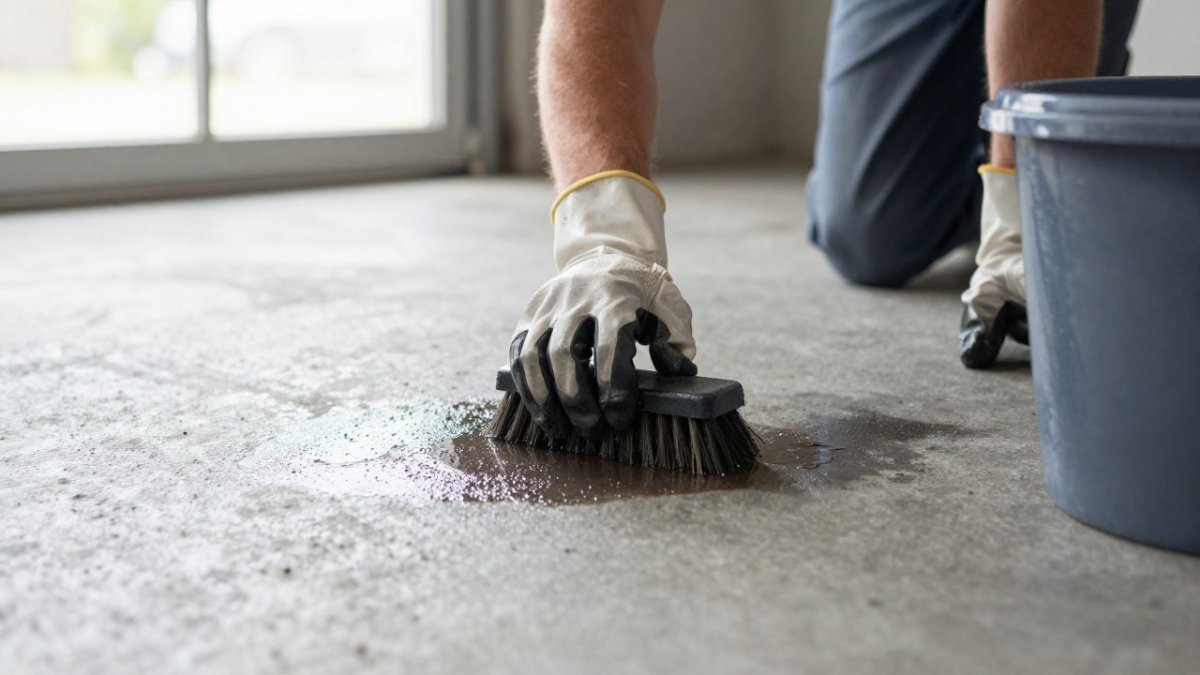
- Ventilate the area. Open doors and windows, or run a fan, before you use any cleaning product indoors.
- Wear protection. Use nitrile gloves, eye protection and a mask if the product is strong-smelling.
- Dampen the stain. Wet the area with warm water. This helps the cleaner reach the oil.
- Apply a degreaser. Spread a concrete degreaser or a heavy-duty detergent over the stain. Read the label for the correct strength and dilution.
- Allow dwell time. Leave the product to work for the time the manufacturer advises, usually 10 to 20 minutes.
- Scrub the stain. Use a stiff-bristled brush in small circles, working from the edge of the stain inwards.
- Rinse thoroughly. Remove the cleaner and loosened oil with clean water.
- Repeat if needed. Old stains often need two or three rounds.
Repeat-treatment guidance: a deep stain may lighten rather than vanish. Realistic expectations matter. Many old stains will fade a great deal but may leave a faint shadow, especially on porous or unsealed concrete.
Choosing the Best Oil Stain Remover for Concrete
The best oil stain remover depends on two things: how far the oil has penetrated, and what the concrete surface is finished with. Get either wrong and you either waste effort on a stain that needs a stronger method, or damage a finish that was never designed for harsh chemicals.
Match the product to the stain
Work through this decision path rather than reaching for the strongest product on the shelf.
- Fresh spill, still wet: no chemical needed yet. Absorb first, then follow with a mild detergent wash. A heavy-duty degreaser here is overkill and adds rinse water you then have to deal with.
- Light set-in film, dull but shallow: a mild detergent or a diluted degreaser is enough. Work it in with a stiff brush, give it the label dwell time, and rinse.
- Set-in grease with a tacky feel: a heavy-duty degreaser is the right tool. These are formulated to break the bond between oil and the concrete pore, and they need the full dwell time to work.
- Deep, long-standing stain with a halo: an alkaline concrete cleaner or a repeated degreaser cycle. Expect two or three rounds rather than one, and judge the result only once the floor is fully dry.
Match the product to the finish
Concrete is not one surface. The same degreaser that rescues a bare garage floor can dull a sealed or polished floor beyond repair.
- Bare, unsealed concrete: the most forgiving surface. Pores are open, so oil penetrates fast, but cleaners also reach it. Strong alkaline cleaners and stiff brushing are acceptable here.
- Sealed concrete: the sealer is a sacrificial layer. Use the mildest product that shifts the stain, avoid aggressive brushing, and check a hidden patch first. If the stain has breached the sealer, the sealer itself may need attention rather than the concrete beneath.
- Painted concrete: solvent-heavy products can lift paint. Stick to detergents and diluted degreasers, keep dwell times short, and rinse promptly.
- Polished concrete: the least tolerant finish. Abrasive brushing and strong alkalines can etch the surface. Use a pH-neutral or mild alkaline product, a soft brush, and short contact times.
Quick comparison
| Option | Best for | Effort | Surface caution |
|---|---|---|---|
| Absorbent powder | Fresh spills | Low | Safe on all finishes |
| Mild detergent | Light film, painted or polished floors | Low | Rinse promptly on painted surfaces |
| Heavy-duty degreaser | Set-in grease on bare or sealed concrete | Medium | Test on sealed and polished finishes |
| Alkaline concrete cleaner | Deep, long-standing stains on bare concrete | High | Avoid on polished and painted surfaces |
For most garage and workshop floors, a heavy-duty degreaser gives the best balance of result and effort, but only after you have confirmed the finish tolerates it. Always test any product on a small, hidden area first and check that it does not discolour or dull the surface.
Watch out: mixing cleaning chemicals can release harmful fumes. Use one product at a time and rinse the surface between applications.
Steam Cleaning Oil Stains From Concrete: What Works and What Does Not
Steam can help loosen oil and grease, especially on light to moderate stains. After steaming, porous concrete may need a gentler approach to avoid driving residue deeper into the surface, as CTi of Acadiana, LLC notes when discussing safe slab cleaning.
Steam on its own rarely removes a deep, long-set stain. See how steam compares with built-up grease to judge whether it suits your floor. The oil needs a chemical to break it down.
For a steam cleaner, follow the operating and maintenance instructions supplied with your machine. Pure Steam Cleaners offers a range of commercial and industrial steam cleaners, including the Pure v6-D and Pure i6-SV, which combine steam with vacuum and detergent injection.
How Long to Leave Oil Stain Remover on Concrete
Dwell time is where most DIY oil removal succeeds or fails. Too short and the product never breaks the oil’s bond with the concrete pore. Too long and the cleaner dries onto the surface, leaving a film that attracts dirt and can be harder to shift than the original stain.
The mechanism is simple: a degreaser needs contact time to surround and lift the oil. Once the product dries, that action stops, and what remains is a residue you then have to scrub off. Keeping the surface damp, not flooded, is the practical skill.
Working dwell times
- Fresh films and light detergent washes: 5 to 10 minutes.
- Set-in grease with a heavy-duty degreaser: 10 to 20 minutes.
- Deep stains and alkaline cleaners: follow the product label exactly, and do not let the cleaner dry out. Mist lightly with water if the surface starts to dry.
These are starting points, not guarantees. The label on the product you are using always wins, because strong alkalines can damage some concrete finishes if left too long.
How to tell the product is still working
A working degreaser keeps the surface visibly damp and slightly slick. If the patch looks dry and chalky, the product has stopped working, mist it or reapply rather than scrubbing harder. If the stain darkens and softens under the brush, the oil is lifting; keep going within the label time. If nothing changes after the full dwell time, the stain is deeper than the product can reach and needs a repeat cycle or a stronger method.
Repeat treatments and realistic expectations
One pass rarely removes a deep stain. A common pattern is two or three cycles, with the stain lightening each time. Judge the result only once the floor is fully dry, because wet concrete always looks darker than it is.
Set expectations honestly: many old stains fade a great deal but leave a faint shadow, especially on porous or unsealed concrete. That shadow is oil that has penetrated beyond the reach of surface cleaners.
Watch out: do not top up a drying product with a different chemical to ‘boost’ it. Use the same product, keep it damp, and rinse fully between cycles.
Rinsing, Disposing of Waste Water and Checking the Result
Rinsing is a step many people rush. Residue left on the concrete attracts dirt and can create a sticky patch.
- Rinse with clean water, working from the outside of the stain towards the centre.
- Collect the dirty water with a wet vacuum or mop where possible.
- Do not let the waste water run into drains, soakaways or watercourses (Pollution prevention for businesses). Check local rules for disposing of oily wastewater.
- Allow the floor to dry fully before you judge the result. Wet concrete can look darker than it really is.
Once dry, look at the stain in good light. If a faint mark remains, repeat the cleaning steps. Some discolouration on older concrete is normal and may not disappear completely.
Booking a Steam Clean for Your Concrete Floor
If the stains cover a large area, or you have tried the steps above without success, a professional steam clean may save time. Pure Steam Cleaners supplies commercial and industrial steam machines. Browse the full range to find a model suited to your floor size and the type of mess you deal with.
Frequently Asked Questions
How do you remove oil stains from a concrete floor?
Start by absorbing as much oil as possible with cat litter, sand or bicarbonate of soda, then leave it for several hours to draw the oil up. Sweep the absorbent away and apply a degreaser or heavy-duty detergent mixed with warm water. Scrub with a stiff-bristled brush, leave the cleaner to dwell as the product label directs, then rinse thoroughly. Repeat if a shadow remains, as deep stains often need more than one treatment.
Can oil stains be removed from concrete once they have dried?
Yes, although set-in stains usually take longer and several applications. Once oil has soaked into the concrete, a surface detergent alone rarely lifts it, so an extraction-type degreaser that is designed to draw oil out of porous material is more effective. Expect a faded mark rather than a completely invisible one on older or heavily used concrete, and check the surface after each treatment.
Does steam cleaning remove oil stains from concrete?
Steam cleaning can loosen and lift surface oil and grime, particularly when combined with a degreaser, and it works well on fresh residue. It is less reliable on deep, old stains, where heat may soften the oil without fully drawing it out. Pure Steam Cleaners’ machines, such as the Pure i6-SV, combine steam with a detergent supply. Results on very old stains will vary.
How long should an oil stain remover stay on concrete?
Follow the dwell time on the product label, which typically ranges from around 10 to 30 minutes for a light degreaser and longer for a heavy-duty extraction product. Do not let the cleaner dry on the surface, as this can leave a residue. For deeply set stains, you may need to reapply and leave it again rather than extending a single application for hours.
