
Commercial & Industrial Steam Cleaners | Pure Steam Cleaners.uk


Table of Contents
- Why Chemical Free Cleaning for Food Plants Is Gaining Ground
- What You’ll Need Before You Start
- Step 1: Map Your Food Plant Sanitation Procedures
- Step 2: Build a Food Factory Cleaning Checklist
- Step 3: Choose the Right Steam Cleaning Equipment for Food Plants
- Step 4: Train Staff to Use Steam Safely and Consistently
- Step 5: Run Food Hygiene Cleaning Validation
- Common Mistakes to Avoid with Chemical Free Cleaning
- Frequently Asked Questions
Last Updated: October 13, 2026
Why Chemical Free Cleaning for Food Plants Is Gaining Ground
Chemical free cleaning for food plants is the practice of removing grease, soil and residue from production surfaces using only steam and water, with no detergent or sanitiser chemicals added. At Pure Steam Cleaners, we have spent 30 years building machines for exactly this job. The shift is being driven by cost, risk and regulation all at once.
The case for switching is straightforward: dry steam at pressure lifts grease and kills surface bacteria on contact, then flashes off, leaving nothing behind but a dry surface.
Steam cleaning replaces both the cleaning step and the rinse step.
Below, we break the transition into seven practical steps, from mapping your current sanitation procedures through to validating the results.
What You’ll Need Before You Start
Three things make the difference between a smooth rollout and a stalled one.
- A written map of your current cleaning regime, including every surface, frequency and product used
- A nominated person who owns the transition and signs off on results
- A steam unit sized to your production hall, not to a domestic kitchen
You will also need a way to record results. A simple log sheet is enough to begin with. What matters is that you can show an inspector what was cleaned, when, and by whom.
Think about your water supply too. Hard water areas punish cheap steam equipment. Limescale builds in the boiler and performance drops within months. Our machines use copper boilers with external heating elements, so limescale does not take hold the way it does in other designs.
Step 1: Map Your Food Plant Sanitation Procedures
Start by writing down what actually happens now, not what the manual says should happen.
Walk the floor and list every food contact surface, every machine, every drain and every high-touch point. Note how each one is cleaned today, how often, and with what.
Then group them by difficulty:
- Easy: open stainless steel tables, trays, panels
- Awkward: conveyors, mixers, pipework joints, behind equipment
- Stubborn: ovens, grills, fryers, baked-on carbon
This map becomes your priority order. Steam handles the easy and awkward groups quickly. The stubborn group needs the higher pressure and volume that only heavier equipment delivers.
Skipping this step is the single most common mistake we see. Teams buy a machine, point it at the dirtiest surface in the plant, get a poor result, and conclude steam does not work.
Step 2: Build a Food Factory Cleaning Checklist
A food factory cleaning checklist turns your map into a repeatable routine. Without one, cleaning quality drifts within weeks.
Build it as a table, one row per surface or asset.
| Surface / Asset | Method | Frequency | Sign-off |
|---|---|---|---|
| Stainless prep tables | Steam, dry cloth | After each shift | Line supervisor |
| Conveyor belts | Steam + vacuum extraction | Daily | Hygiene lead |
| Mixer bowls and blades | Steam, dismantled | After each batch | Operator |
| Oven interiors | Dry steam | Weekly | Hygiene lead |
| Floor drains | Steam jet | Daily | Cleaning contractor |
| Door handles, panels | Steam, quick pass | Twice daily | Any trained staff |
Keep it to one page. If it runs longer, staff stop reading it.
Step 3: Choose the Right Steam Cleaning Equipment for Food Plants
Match the machine to the job. Food plants need three things from steam equipment: enough pressure to shift baked-on grease, enough steam volume to work continuously, and a build that survives daily industrial use.

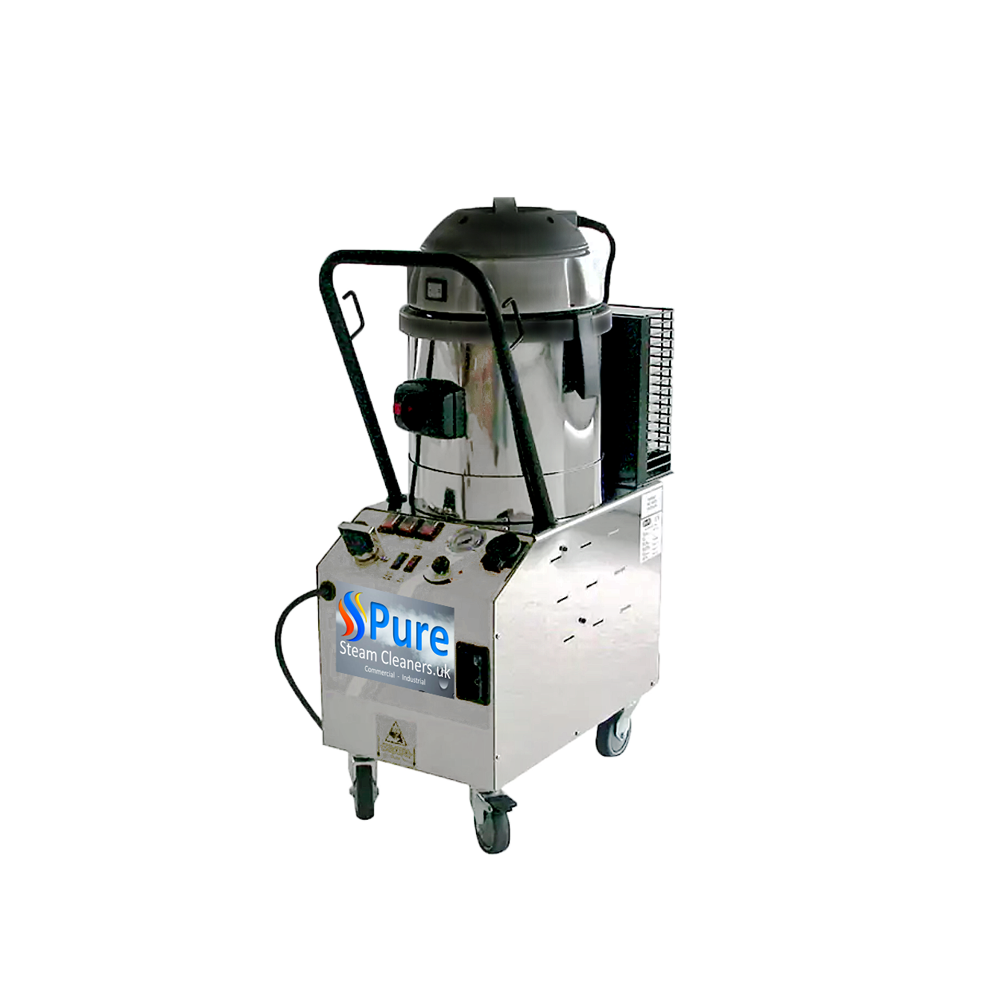
For most food production halls, we point people to the Pure i8 Heavy Duty Industrial Steam & Vacuum Cleaner. It produces steam at 8 bar and 60 g/min, with a 10-litre reservoir giving over three hours of continuous running. The 23-litre waste tank and two-stage vacuum mean you steam and extract in one pass, which matters when you cannot afford standing water near production lines.

Smaller sites, such as a catering kitchen or a contract cleaner covering mixed clients, are better served by the Pure i6-SV or the Pure i6-SO. Both run 3 x 1000W elements through a standard plug, producing 53 g/min at 6 bar.
Pure i8 Heavy Duty Industrial Steam & Vacuum Cleaner →

If your site is in a hard water area, check the boiler design before you buy anything. Copper boilers with external elements are not affected by limescale the way internal-element designs are. We recommend rinsing the boiler once a month, which takes about five minutes.
Step 4: Train Staff to Use Steam Safely and Consistently
Steam at 6 to 8 bar is not a mop. Train for safety first, then for consistency.
Cover these points in a single session:
- Keep the jet moving; never hold it on one spot
- Never point steam at skin, and never at electrical panels
- Let surfaces cool before touching them
- Use the vacuum function on the same pass to remove loosened soil
- Log every clean as you go, not at the end of the shift
Then watch each operator run one full surface unaided. Sign them off only when the result matches the checklist standard. Refresher training every six months keeps habits sharp.
Step 5: Run Food Hygiene Cleaning Validation
Food hygiene cleaning validation is the evidence that your process actually works. Inspectors do not take “it looks clean” as an answer.
Validation has two parts. First, visual checks against the checklist. Second, surface testing after cleaning. Common methods include swabs for protein residue and ATP testing, which gives a reading in seconds.
Follow this sequence:
- Clean the surface using your new steam routine
- Let it dry fully
- Swab a defined area, typically 10cm x 10cm
- Record the reading against your pass threshold
- Re-clean and retest any surface that fails
Run validation across all three surface groups from Step 1. Keep every result. A folder of dated readings is worth more in an inspection than any certificate on the wall.
For the regulatory side, the Food Standards Agency publishes guidance on cleaning and disinfection in food businesses that sets out what inspectors expect to see. Your local authority environmental health team can also advise on record-keeping for your specific operation.
Common Mistakes to Avoid with Chemical Free Cleaning
Most failed rollouts trace back to four errors.
- Buying undersized equipment. A light commercial unit will not clear baked-on carbon in a production oven. Match the machine to the hardest job, not the easiest.
- Dropping the rinse step without checking. Steam leaves a dry surface, but confirm this on your own surfaces before you remove the rinse from the checklist.
- Skipping validation. Without readings, you have no proof. Inspectors will ask.
- No maintenance routine. Boilers need a monthly rinse. Teams that skip it see performance drop and blame the machine.
Get those four right and the transition can be highly beneficial.
Moving a food plant to chemical free cleaning is a change of process, not just a change of equipment, and the plants that get it right are the ones that map, train and validate before they scale up. Pure Steam Cleaners builds machines for exactly this environment, with patented self-descaling boiler technology, a 3-year boiler guarantee, and free next working day delivery on orders placed before 1pm. Every unit is Defra qualified and backed by 30 years of experience across more than 100 sectors. Get started with Pure Steam Cleaners and put a steam routine in place that stands up to inspection.
Frequently Asked Questions
How can food plants clean equipment without chemical cleaners?
Dry steam at pressure lifts grease, fat and protein residues from stainless steel, conveyors, mixers and trays, then a vacuum stage removes the loosened soil. Because no chemical residue is left behind, equipment can often be returned to service after surfaces are dry. Chemical free cleaning works best when it sits inside written procedures, a checklist and a validation routine, not as a one-off swap of one tool for another.
Can steam cleaning replace every cleaning and disinfection step?
No. Steam handles grease, residues and many surface contaminants well, but some tasks may benefit from a detergent stage, such as chewing gum removal. Food plant sanitation procedures should state which surfaces are steam-only and which may need a pre-treatment. Your food hygiene cleaning validation then proves the combined method meets the standard your customers and auditors expect.
How can a food plant validate a new cleaning method?
Start by defining what clean means for each surface, then run the new method alongside your existing one on the same equipment type. Record steam pressure, contact time, surface temperature and operator, and take swabs or visual checks at set points. Repeat across several production runs so the results are consistent. Keep the records with your food factory cleaning checklist so auditors can trace the change from trial to routine.
What should a food plant assess before introducing steam cleaning?
Check the surfaces you plan to treat, since some sealants and soft plastics are sensitive to heat. Confirm water quality and how the boiler handles hard water, because limescale is the most common cause of breakdowns. Review power supply, drainage and drying time against your production schedule. Finally, decide which staff will operate the machine and how they will be trained before the first live run.
