
Commercial & Industrial Steam Cleaners | Pure Steam Cleaners.uk


Table of Contents
- What an Industrial Steam Cleaner for Food Production Actually Needs to Do
- Industrial Steam Cleaner Comparison: Types and Specifications
- HACCP Steam Cleaning Requirements in Food Production
- Steam Cleaning vs Chemical Cleaning in Food Production
- Choosing a Dry Steam Cleaner for Food Processing Lines
- Pricing, ROI and What to Check Before You Buy
- Frequently Asked Questions
Last Updated: September 24, 2026
What an Industrial Steam Cleaner for Food Production Actually Needs to Do
An industrial steam cleaner for food production is a machine that uses high-temperature dry steam to remove grease, protein residue and biofilm from processing equipment without leaving chemical traces behind. In practice, that means it must reach the surfaces your hygiene schedule actually covers, and do it fast enough that cleaning windows do not eat into production time.
This guide from Pure Steam Cleaners sets out what matters when you specify a machine: the standards it has to satisfy, how steam compares with the chemicals your team already knows, and which specifications separate a workhorse from a machine that spends more time in the workshop than on the line.
Most buying guides treat steam cleaners as one category. They are not.
The deciding factor in food production is rarely peak temperature on a spec sheet. It is whether the machine holds that temperature through a full shift without scaling up or losing pressure.
Industrial Steam Cleaner Comparison: Types and Specifications
There are three broad machine types sold into food environments, and each suits a different pattern of work. The right choice depends on how far your team walks between cleaning points, how much open floor you have, and whether the equipment being cleaned can tolerate moisture.
How the Main Machine Types Differ
Dry steam machines produce steam with very low moisture content, so surfaces are left close to dry and water does not pool in motors, control panels or electrical housings. These suit conveyor systems, mixers, ovens and packaging machinery where wet cleaning creates risk.
Wet steam machines carry more water in suspension and shift heavy, baked-on carbon and grease faster, but they leave surfaces wet and usually need a follow-up wipe-down.
Central steam systems pipe steam from a fixed boiler to multiple outlets around a plant. They are efficient at scale but expensive to install and inflexible once fitted.
| Type | Best For | Key Limitation | Cleaning Time Impact |
|---|---|---|---|
| Dry steam (portable) | Conveyors, control panels, motors | Lower moisture means slower on heavy carbon | Fast on light to medium soil |
| Wet steam (portable) | Ovens, baking trays, heavy grease | Leaves surfaces wet, needs drying step | Fast on heavy soil |
| Central steam system | Large plants, fixed cleaning points | High install cost, no flexibility | Fastest across a large footprint |
Specifications That Decide the Purchase
Boiler material matters more than most buyers expect. A stainless steel boiler resists scale and corrosion far better than mild steel, particularly in hard water areas where limescale is the single biggest cause of premature failure.
Pressure and temperature determine how quickly soil releases. Higher pressure shifts baked-on grease faster; sustained temperature is what actually kills microorganisms. Look for continuous rating, not a peak figure.
Recovery time between refills decides whether one machine can cover a full line or whether you need two. A machine that needs a 20-minute cooldown every hour will not keep pace with a double shift.
A common mistake is buying on peak temperature alone. A machine rated at a high peak but with a small boiler will drop pressure after a few minutes of continuous use, right when your team is working through the dirtiest section of the line.
HACCP Steam Cleaning Requirements in Food Production
HACCP steam cleaning requirements are not a separate set of rules. Steam cleaning has to slot into the same hazard analysis, monitoring and verification framework you already run for any other cleaning method, with documented evidence that it works.
Under Food Standards Agency guidance on HACCP, you need to identify cleaning as a control point where it manages a hazard, set a measurable limit, monitor it, and keep records. Steam fits that structure well because temperature and contact time are both measurable.
What inspectors look for in practice:
- A written cleaning procedure naming steam as the method for specific equipment
- Recorded temperatures and dwell times for each critical surface
- Evidence that staff are trained on the equipment
- Verification that the method achieves the required reduction in contaminants
The practical advantage is documentation. A steam machine with a digital temperature readout gives you a number to log. A bucket of chemical gives you a dilution ratio someone has to verify by hand.
Steam Cleaning vs Chemical Cleaning in Food Production
Steam cleaning versus chemical cleaning in food production usually comes down to three things: residue risk, consumable cost and how much time the process takes. Steam wins on residue and consumables; chemicals still win on some heavy carbon removal jobs.
Chemical cleaning leaves a residue that must be rinsed and verified. That rinse step costs water, time and labour, and it introduces a failure point: if rinsing is incomplete, residue carries into the next production run. Steam leaves no chemical residue, so there is nothing to rinse and nothing to verify chemically.
The trade-off is real, though. On thick, polymerised carbon, a caustic soak does work that steam alone will not shift quickly. Many plants run a hybrid: steam for routine daily cleaning and chemical soak for periodic deep cleans on specific equipment.
| Factor | Steam Cleaning | Chemical Cleaning |
|---|---|---|
| Residue risk | None, no rinse needed | Requires verified rinse |
| Consumable cost | Water and power only | Ongoing chemical spend |
| Heavy carbon removal | Moderate | Fast |
| Surface compatibility | Avoid on heat-sensitive plastics | Depends on chemical |
| Documentation | Temperature and time logged | Dilution and contact time logged |
Health and Safety Executive guidance on COSHH requires you to assess and control exposure to hazardous substances. Reducing chemical use removes a whole category of risk assessment, storage and PPE burden from your operation.
If you are switching from chemicals, run steam alongside your existing method for two weeks on one line. Log the time each takes and the results. That comparison is far more persuasive to a finance director than any supplier claim.
Choosing a Dry Steam Cleaner for Food Processing Lines
A dry steam cleaner for food processing is the right choice when moisture itself is a hazard: around motors, control cabinets, electrical panels and any surface that must be production-ready within minutes. The low moisture content is what makes it viable where a wet method is not.
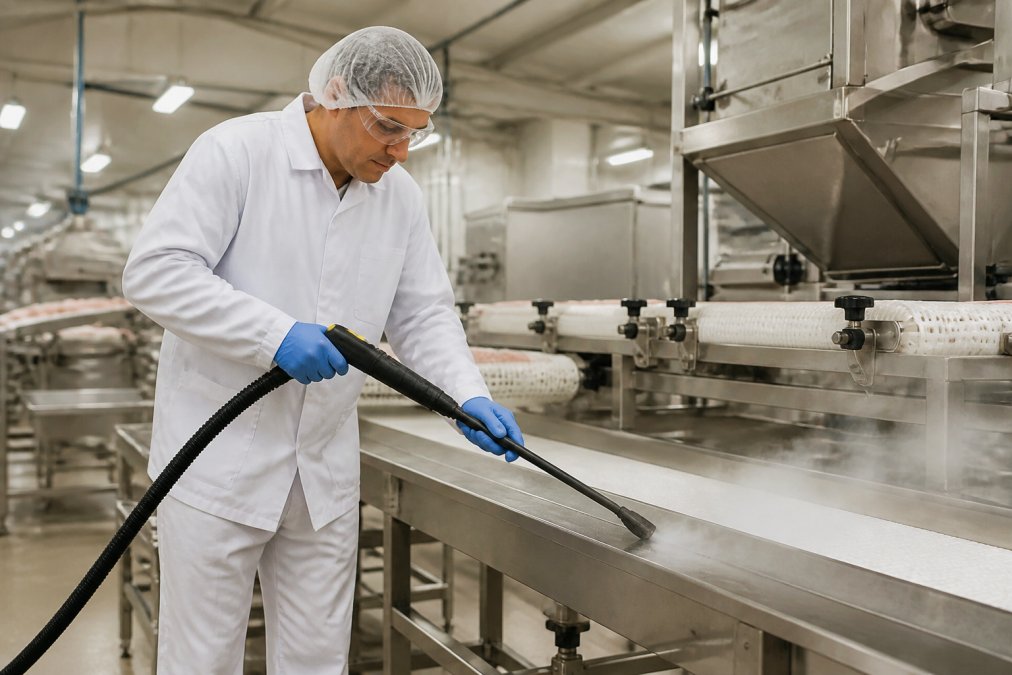
Match the machine to the line, not the other way round. Walk your cleaning route and note how many metres of hose you need, how many power points are available, and where the machine will sit between uses. A machine that has to be carried up stairs twice a shift gets used less than one that stays on the floor.
Accessories decide how much of your line you can actually reach. Long lances get into conveyor housings and behind guards. Brush attachments lift soil from textured surfaces. Small nozzles concentrate pressure where it matters.
Boiler construction is where reliability is won or lost. In hard water areas, scale builds inside the boiler and reduces both pressure and temperature over time. A self-descaling boiler design removes that failure mode rather than asking your maintenance team to manage it.
Pricing, ROI and What to Check Before You Buy
Pricing for industrial steam cleaning equipment depends on boiler size, pressure rating, build materials and accessories, so it is quoted per specification rather than sold off a fixed price list.
Work out your own payback:
- Add up annual chemical spend for the equipment you would switch
- Estimate labour hours currently spent rinsing and verifying residue removal
- Estimate the value of production hours recovered from faster cleaning
- Compare the total against the machine cost, and divide to get months to payback
Do not buy on price alone. A cheaper machine with a mild steel boiler in a hard water area will scale up and lose performance within months, and the replacement cost wipes out the saving.
Pure Steam Cleaners builds machines with patented self-descaling boiler technology, backed by a 3-year boiler guarantee and 30 years of experience supplying commercial and industrial cleaning equipment. Every unit is Defra qualified, and orders placed before 1pm ship for free next working day delivery.
Frequently Asked Questions
Why is dry steam cleaning preferred in food production?
Dry steam carries very little moisture, so surfaces are left almost immediately dry and production can restart sooner. That reduces the risk of water pooling in electrical panels, motors and control boxes, which matters on food processing machinery. It also means no chemical residue remains on food contact surfaces, so there is no rinse step and no risk of taint. For lines that run to tight changeover schedules, the faster turnaround is often the deciding factor.
Does steam cleaning meet Food Standards Agency hygiene requirements?
Steam cleaning supports the hygiene outcomes the Food Standards Agency expects: surfaces that are visibly clean and free from contamination. The legal duty is to manage food safety under HACCP-based procedures, and steam fits those procedures well because it leaves no chemical residue on food contact surfaces. You still need to document the method, contact time and verification in your food safety management system, and check that the machine suits the surface being cleaned.
Can industrial steam cleaners be used on sensitive food processing machinery?
Yes, with care. Dry steam cleaners are commonly used on conveyors, mixers, filling heads, ovens and stainless steel frames. Keep the lance moving, hold a sensible distance from bearings, seals, wiring and electronic controls, and follow the machine manufacturer’s cleaning instructions. For a food production site, choose a unit with adjustable pressure and a dry steam setting so you can match the output to delicate components without forcing water into places it should not go.
How does steam cleaning reduce the need for chemical sanitisers?
Steam at temperature kills micro-organisms on contact and lifts grease, so many cleaning tasks that previously needed a degreaser and a separate sanitiser can be handled in one pass. That cuts chemical purchasing, storage, dosing and rinsing, and removes the residue risk on food contact surfaces. Most sites still keep a sanitiser for specific tasks, but the volume used typically falls, which reduces both cost and the paperwork attached to chemical handling under COSHH.
