
Commercial & Industrial Steam Cleaners | Pure Steam Cleaners.uk

Table of Contents
- Steam Cleaner Temperature for Disinfection: What Actually Kills Bacteria
- Does Steam Cleaning Kill Bacteria Effectively on Common Pathogens?
- Steam Sanitation vs Chemical Disinfection
- How to Meet CQC Hygiene Standards with Steam
- Step-by-Step: How to Steam Clean for Effective Bacteria Removal
- Common Mistakes That Stop Steam Cleaning Killing Bacteria
- Frequently Asked Questions
Last Updated: 28 September 2026
Steam Cleaner Temperature for Disinfection: What Actually Kills Bacteria
The question of does steam cleaning kill bacteria effectively comes down to whether the steam reaches a high enough temperature and stays in contact with the surface long enough. Most pathogens need sustained heat above 70°C to be destroyed, and professional steam cleaners produce steam far hotter than that, typically between 150°C and 180°C at the nozzle.
The science is straightforward. Heat denatures bacterial proteins and breaks down cell walls. Once that happens, the organism cannot survive or reproduce. This is why steam is classed as a physical kill method rather than a chemical one.
But temperature alone does not guarantee results. Contact time matters just as much. A quick pass over a worktop will not do the job. The steam needs a few seconds of direct contact to transfer enough heat into the surface.
At Pure Steam Cleaners, we have spent three decades building machines for exactly this purpose. Our patented self-descaling boiler technology keeps pressure and temperature consistent, which is what separates a reliable kill from a patchy one.
Here is the key point most guides skip: steam cleaner temperature for disinfection is only useful if the machine can hold that temperature during continuous use. Cheap units drop off after a few minutes. Professional-grade equipment does not.
Steam kills bacteria through heat, not chemicals. The two variables that decide success are nozzle temperature (above 70°C minimum, ideally 150°C+) and contact time (several seconds per patch of surface).
Does Steam Cleaning Kill Bacteria Effectively on Common Pathogens?
Yes, steam cleaning kills most common pathogens effectively, including E. coli, Salmonella, Listeria, and Staphylococcus aureus. These organisms are all heat-sensitive and break down quickly when exposed to steam above 70°C.
Different bacteria need different conditions, though. Here is a quick breakdown:
- E. coli and Salmonella: Destroyed rapidly at temperatures above 70°C, common in food prep areas
- Listeria: Slightly more heat-resistant but still eliminated with sustained steam contact
- Staphylococcus aureus: Killed on contact with high-temperature steam on hard surfaces
- Norovirus: A virus rather than a bacterium, but also heat-sensitive and reduced by proper steam treatment
The catch is surface type. Porous materials like unsealed wood or thick grout hold bacteria deeper, so steam needs longer contact to reach them. Hard, non-porous surfaces such as stainless steel, tiles, and glass are far easier to treat.
A common mistake is assuming one fast pass is enough. In practice, you should hold the nozzle over each section for several seconds and let the steam do its work. Move too quickly and you leave live bacteria behind.
Steam Sanitation vs Chemical Disinfection
Steam sanitation and chemical disinfection both reduce pathogens, but they work in completely different ways. Steam uses heat. Chemicals use reactive compounds that break down cell structures.
Each has trade-offs worth understanding before you commit to one approach.
| Factor | Steam Sanitation | Chemical Disinfection |
|---|---|---|
| Kill method | Heat | Reactive chemicals |
| Residue left behind | None | Possible residue |
| Rinse required | No | Often yes |
| Risk to staff | Low (heat only) | Varies by chemical |
| Consumable cost | None after purchase | Ongoing |
| Surface compatibility | Most hard surfaces | Depends on chemical |
The biggest practical difference is what gets left behind. Chemicals can leave residue that needs rinsing, which adds time and water use. Steam leaves nothing but condensation.
There is also the cost angle. Chemicals are a recurring expense. A steam cleaner is a one-off purchase plus electricity. Over time, most operations find the running costs drop.
That said, chemicals still have a place. For some delicate surfaces or specific spore types, a chemical approach may be required. The honest answer is that many facilities use both, choosing steam for routine work and chemicals for targeted jobs.
How to Meet CQC Hygiene Standards with Steam
Meeting CQC hygiene standards with steam comes down to consistency and documentation. The Care Quality Commission expects care providers to show that their cleaning methods actually reduce infection risk, not just that they clean.
Steam fits this framework well because it is chemical-free and repeatable. There is no mixing, no dilution error, and no residue to worry about. Inspectors tend to favour methods that are easy to verify and hard to get wrong.
To build a steam routine that stands up to inspection:
- Write a cleaning schedule that names each surface and how often it is treated
- Record nozzle temperature checks at the start of each shift
- Train staff on contact time so every operator cleans the same way
- Log each steam session with date, area, and operator initials
- Keep equipment service records, including boiler descaling
- Review infection rates and adjust the schedule if needed
The documentation is what inspectors look for. A machine that works brilliantly but has no records is harder to defend than a simple routine with clear logs.
For care homes and hospitals, the appeal of steam is that it removes the variable of chemical strength. Staff cannot under-dose or over-dose. They just apply heat for the right amount of time.
Step-by-Step: How to Steam Clean for Effective Bacteria Removal
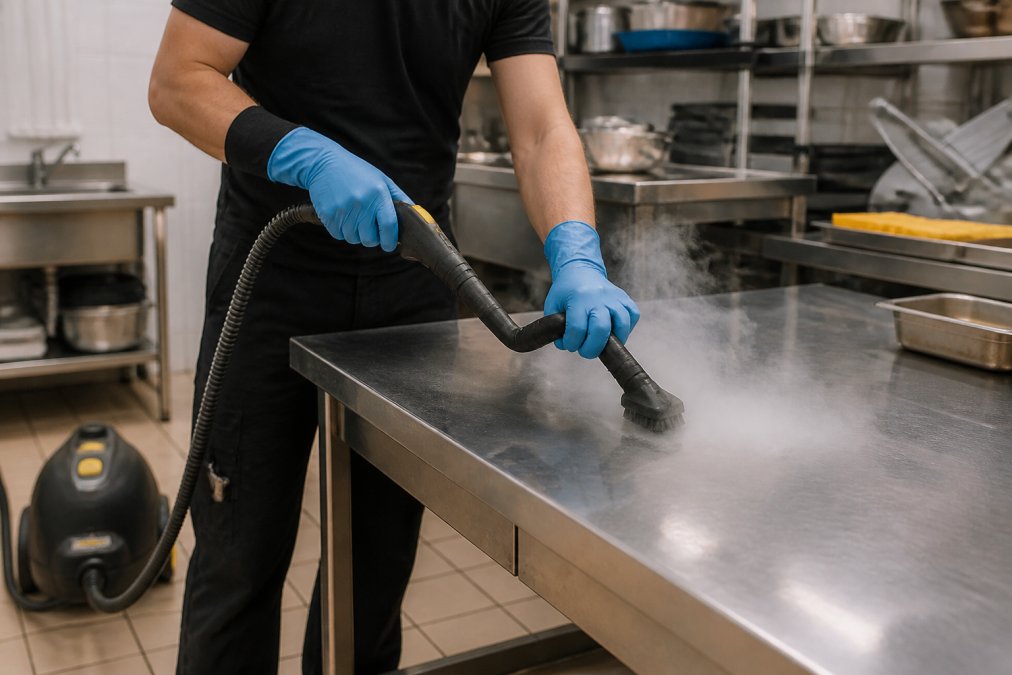
Follow these steps to get a reliable kill every time. Skipping any of them weakens the result.
- Clear the surface. Remove loose debris, food, or grease first. Steam works best on a surface that is already free of heavy soil.
- Check your temperature. Confirm the machine has reached full operating temperature before you start. Cold starts waste time and leave bacteria alive.
- Work in sections. Treat one manageable area at a time, roughly one square metre, so nothing gets missed.
- Hold the nozzle close. Keep the nozzle a few centimetres from the surface. Distance loses heat fast.
- Slow down. Move at a steady pace, giving each patch several seconds of direct steam contact.
- Overlap your passes. Cover each strip twice, overlapping the previous one by half.
- Watch for condensation. A thin film of water on the surface shows the steam is transferring heat.
- Let it dry. Allow the surface to air dry. The heat has already done the work.
- Log the job. Record the area, time, and operator for your hygiene records.
Expected result: A visibly clean, dry surface with no chemical residue and a documented steam treatment.
The thing nobody tells you about steam cleaning is that nozzle distance matters more than most operators realise. Doubling the gap between nozzle and surface can drop the temperature at the point of contact below the kill threshold. Keep it close and keep it slow.
Common Mistakes That Stop Steam Cleaning Killing Bacteria
Most failed steam cleaning comes down to a handful of avoidable errors. Fix these and your results improve immediately.
- Moving too fast. Speed is the number one reason bacteria survive. Slow, deliberate passes work; quick wipes do not.
- Skipping the pre-clean. Heavy grease and dirt insulate bacteria from the heat. Clear the surface first.
- Letting limescale build up. Scale reduces boiler efficiency and drops nozzle temperature. In hard water areas, this happens fast without proper descaling.
- Using a cold or underpowered machine. Domestic units often cannot hold temperature during continuous use.
- Ignoring contact time. Temperature without time does not kill. Both are needed.
- No record-keeping. For regulated environments, an undocumented clean is hard to prove.
Limescale is worth a closer look. In hard water areas, scale builds inside the boiler and slowly strangles performance. Many operators only notice when the machine stops working entirely.
Pure Steam Cleaners solves this with a patented self-descaling boiler, which reduces limescale build-up and keeps performance steady over time. That means fewer breakdowns and less downtime during busy periods.
If you clean in a hard water area and skip descaling, your boiler loses efficiency within months. Nozzle temperature drops, contact time stops being enough, and your kill rate falls without any obvious warning sign.
Keeping a facility genuinely clean and compliant is a daily challenge, and the margin for error in healthcare, food, and care settings is small. Pure Steam Cleaners builds machines that hold their temperature, resist limescale with patented self-descaling boiler technology, and come with a three-year boiler guarantee and free next working day delivery on orders placed before 1pm. With 30 years of experience and Defra qualification behind every unit, we help teams replace harsh chemicals with reliable, repeatable steam sanitation. Get started with Pure Steam Cleaners and build a hygiene routine your inspectors can trust.
Frequently Asked Questions
Does steam cleaning kill 99.9% of bacteria?
Steam cleaning can reduce bacteria by up to 99.9% when the correct temperature and contact time are used. The key is reaching at least 100°C at the surface for long enough to penetrate. In practice, results depend on the machine, the surface, and how slowly the operator moves the nozzle. Dry steam at higher pressures penetrates porous surfaces more effectively than lower-powered units, so equipment specification matters as much as technique.
What temperature is required for steam to kill bacteria?
Most bacteria are destroyed at temperatures above 70°C, but for reliable disinfection in commercial settings, steam should reach 100°C or higher at the point of contact. Some hardy pathogens, including certain spores, need temperatures closer to 120°C and longer exposure. Machines that maintain consistent high temperatures throughout the cleaning cycle give more predictable results than those that lose heat under load.
Can steam cleaning replace chemical disinfectants in healthcare settings?
Steam cleaning can replace chemical disinfectants for many surface-cleaning tasks in healthcare environments, provided the machine reaches sufficient temperature and the operator follows a validated process. CQC inspections focus on outcomes, so documented steam cleaning procedures with temperature logs and contact times can demonstrate compliance. Some high-risk scenarios may still require a chemical step, so check your local infection control policy before switching entirely.
How long must steam be applied to kill pathogens effectively?
Contact time varies by surface and pathogen. Non-porous surfaces such as stainless steel typically need 5 to 10 seconds of direct steam contact at 100°C or above. Porous surfaces like grout or fabric may need 15 to 30 seconds because the steam must penetrate deeper. Slower passes with the nozzle held closer to the surface are more effective than quick sweeps, especially in food processing and clinical areas where biofilm can form.
