
Commercial & Industrial Steam Cleaners | Pure Steam Cleaners.uk


Table of Contents
- Why Steam Cleaning Works for Care Home Hygiene
- Meeting CQC Infection Control Standards With Steam
- What You’ll Need Before You Start
- Step-by-Step: Steam Cleaning for Care Home Hygiene
- Sanitising High-Touch Surfaces in Care Homes
- Reducing Chemical Exposure in Care Settings
- Common Mistakes to Avoid
- Conclusion
- Frequently Asked Questions
Last Updated: October 7, 2026
Why Steam Cleaning Works for Care Home Hygiene
Steam cleaning for care home hygiene works because dry steam at high temperature lifts dirt and kills harmful organisms on contact, without leaving chemical residue behind. This guide from Pure Steam Cleaners explains how to build steam into your daily routine, meet CQC expectations, and keep residents safe.
Care home hygiene is the practice of controlling infection and contamination across a residential setting where people live closely together, often with weakened immune systems.
That last point matters more than most managers realise. Residents in a care setting are more vulnerable to infection than the general public, so the margin for error is smaller. Steam gives you a way to clean and sanitise in one pass, using nothing but water.
Below, we’ll show you exactly how to set up a steam routine that stands up to inspection. But first, here’s what most guides get wrong: they treat steam as a backup to chemicals, when it should be the first tool you reach for.
Steam cleans and sanitises in a single pass. No rinsing, no residue, no waiting for chemicals to work.
Meeting CQC Infection Control Standards With Steam
The Care Quality Commission expects providers to prevent and control infection using a range of measures, and steam cleaning fits squarely inside that framework. The CQC guidance on infection prevention and control sets out that providers must have clean, hygienic premises and equipment, and must follow current national guidance on infection prevention.
Steam supports this in a few concrete ways:
- It reaches the high temperatures needed to kill many pathogens on contact
- It leaves no chemical residue that could harm residents or staff
- It works on the surfaces inspectors check most: handrails, door handles, call buttons, bathroom fittings
Your inspection evidence matters as much as the cleaning itself. Record what you cleaned, when, and with what method. A written steam protocol sits well alongside your existing infection control policy.
Do not assume steam replaces your whole infection control policy. It is one control measure among several, and inspectors will expect a documented, risk-based approach.
What You’ll Need Before You Start
Before you begin, gather the right equipment and prepare the space so the job runs safely and quickly. A commercial steam cleaner with a vacuum function saves time because it lifts loosened dirt as you work.
Your pre-start checklist:
- Commercial steam cleaner with continuous steam output
- Vacuum attachment and brush heads for different surfaces
- Microfibre cloths for finishing and drying
- Mop and bucket for floors after steaming
- Your cleaning schedule and record sheets
- Personal protective equipment for staff
- Signage to keep residents clear of wet areas
Choose a machine built for daily commercial use. The Health and Safety Executive guidance on safe cleaning at work is a useful reference for staff safety, including slips, trips, and safe use of equipment.
Step-by-Step: Steam Cleaning for Care Home Hygiene
The process follows three clear stages: prepare the room, clean from top to bottom, then dry and record. Each stage protects residents and gives you a paper trail for inspection.
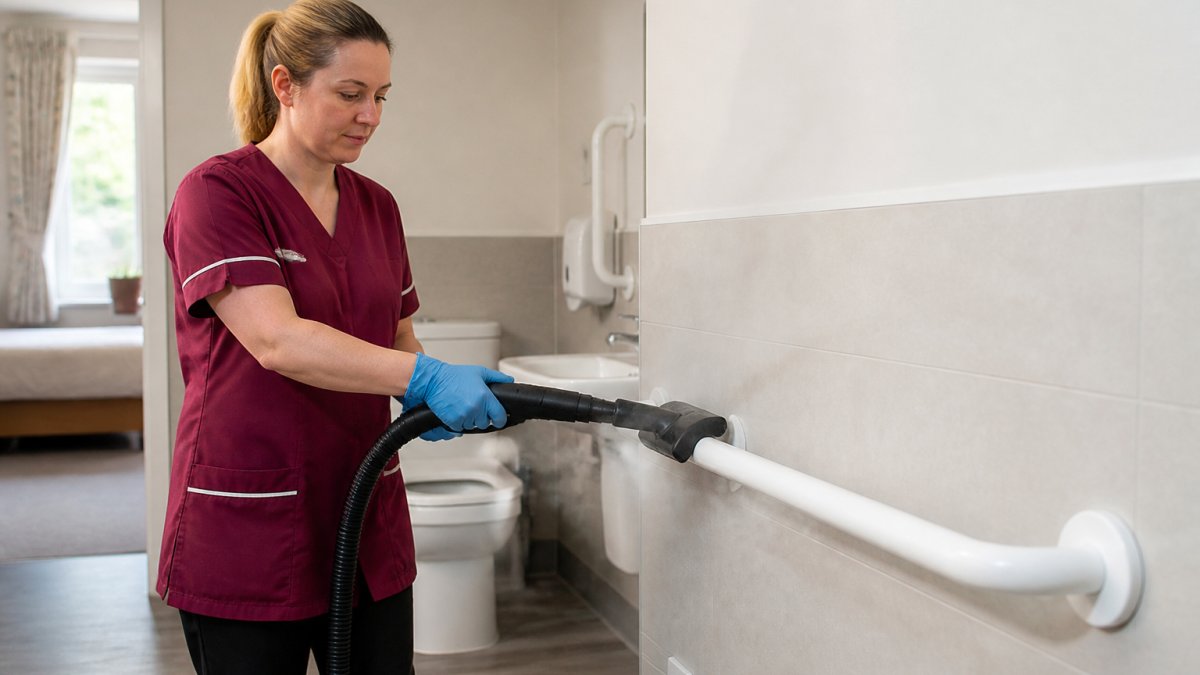
Step 1: Prepare the Room and Protect Residents
Start by telling residents and staff what you are doing and when. Move loose items, check for trailing cables, and put up wet floor signs. Work in one area at a time so residents can stay in familiar surroundings.
Step 2: Work Top to Bottom, Clean to Dirty
Work from the highest points down, and from the cleanest areas toward the dirtiest. This stops dirt from dropping onto surfaces you have already cleaned.
- Steam high-touch points first: handrails, handles, switches
- Move to bathroom fittings, then floors
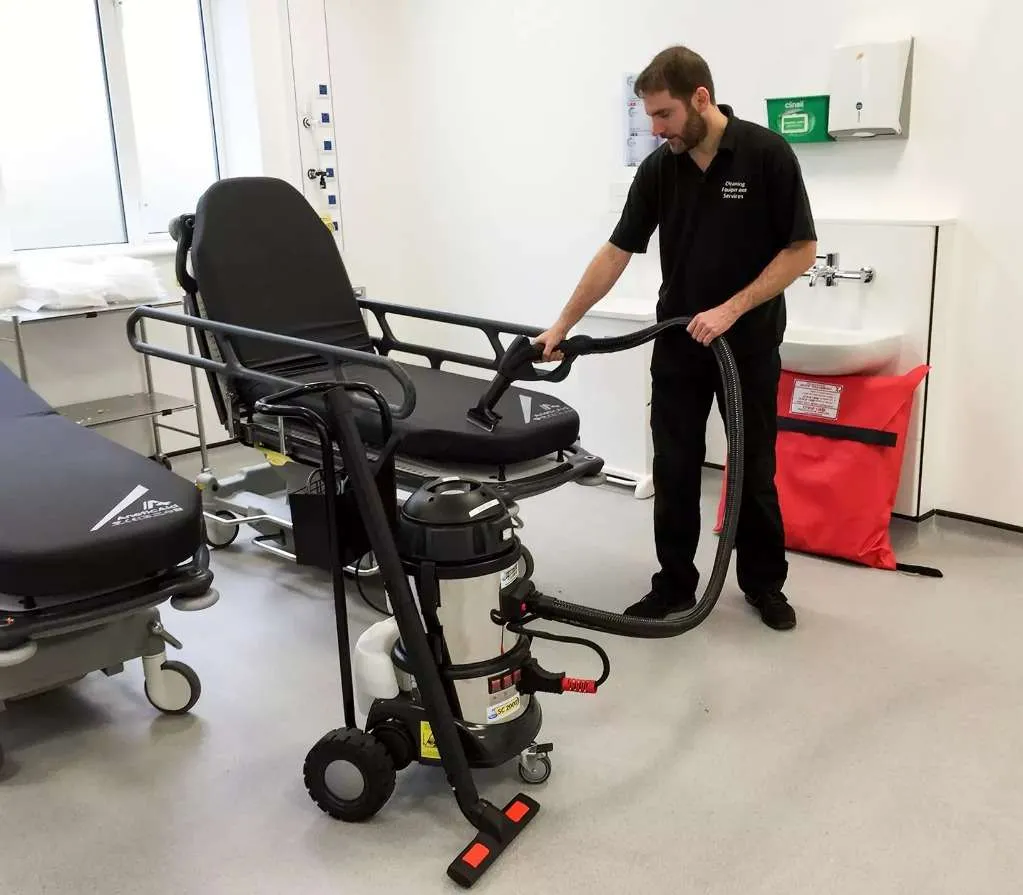
- Use the vacuum function to lift loosened dirt as you go
- Change cloths between areas to avoid spreading contamination
Step 3: Allow Surfaces to Dry and Record the Clean
Steam dries fast, but check each surface before letting residents back in. Then log the clean: the area, the time, the method, and who did it. This record is your proof at inspection.
Pure v6-DT Commercial Steam Cleaner With Vacuum and Detergent →
Sanitising High-Touch Surfaces in Care Homes
High-touch surfaces are where infection spreads fastest, so they need the most attention. Handrails, door handles, light switches, call buttons, and bathroom fittings are touched dozens of times a day.
Sanitising high-touch surfaces in care homes means cleaning these points more often than general surfaces, and steam makes that practical because there is no chemical dwell time to wait for.
A simple daily rotation:
| Surface | How Often | Steam Method |
|---|---|---|
| Handrails and door handles | Twice daily | Direct steam, wipe dry |
| Call buttons and switches | Twice daily | Steam with brush head |
| Bathroom fittings | Daily | Steam, then dry |
| Dining tables | Before each meal | Steam, wipe, air dry |
Reducing Chemical Exposure in Care Settings
Reducing chemical exposure in care settings protects residents and staff at the same time. Many traditional cleaning products release fumes that can irritate the airways, which is a real concern where residents have breathing conditions.
Steam uses water alone for most tasks, so you cut down on the number of products stored, mixed, and applied. That also lowers the risk of a staff member mixing the wrong chemicals together.
Where you do need a detergent for heavy soiling, choose a machine that lets you control the dose. The Pure v6-DT commercial steam cleaner with vacuum and detergent allows switchable, adjustable detergent injection, so you use only what the job needs. For areas where you want steam alone, the Pure v6-T commercial steam and vacuum cleaner gives you 6 bar pressure and continuous steam without any chemicals at all.
Run a short steam pass over handrails at the start of each shift. It takes minutes and keeps the busiest touch points under control all day.
Common Mistakes to Avoid
Most problems with steam come down to technique, not the machine. Here are the mistakes we see most often.
- Steaming over dirt without vacuuming. Loosened grime settles back down. Use the vacuum function as you work.
- Skipping the drying check. Wet floors are a slip risk. Always confirm surfaces are dry.
- No written record. An unwritten clean is hard to prove at inspection.
- Using one cloth everywhere. This spreads contamination between areas.
- Ignoring hard water. In hard water areas, limescale builds up and shortens machine life. Look for a boiler designed to resist it.
That last point catches out a lot of care homes. A machine with a self-descaling boiler and a quick monthly clean-out keeps running without constant maintenance.
Conclusion
Keeping a care home hygienic while protecting residents from harsh chemicals is a genuine balancing act. Pure Steam Cleaners builds machines that make it simpler, with chemical-free steam cleaning, patented self-descaling boiler technology, and a 3-year boiler guarantee. Our equipment is Defra qualified and backed by 30 years of experience. Get started with Pure Steam Cleaners and build a steam routine that stands up to inspection.
Frequently Asked Questions
How does steam cleaning support CQC infection control requirements?
Steam cleaning supports CQC infection control standards by using high-temperature dry steam to clean and sanitise surfaces without relying on chemical residues. The CQC expects care providers to maintain clean, hygienic environments and to follow evidence-based infection prevention practice. Steam reaches grout lines, handrails and fittings that cloths can miss, and because it leaves no chemical film, surfaces are ready to use straight after drying. Documenting steam cleaning as part of your daily and deep-clean schedule gives inspectors a clear audit trail of how you meet those standards.
Is steam cleaning effective for sanitising high-touch surfaces in care homes?
Yes. High-touch surfaces such as door handles, call buttons, handrails, light switches and grab rails are where cross-contamination spreads fastest. Steam cleaning at 6 bar with a continuous steam output of around 43 g/min lets you sanitise these points quickly and repeatably throughout the day. Because no rinsing is needed, staff can move from one touchpoint to the next without waiting. Pair steam with a colour-coded microfibre system and a documented schedule so every high-touch surface is covered at least once per shift.
What are the benefits of reducing chemical exposure in care settings?
Reducing chemical exposure in care settings lowers the risk of skin irritation, respiratory irritation and allergic reactions among residents and staff who spend long hours in the same rooms. It also removes the need to store, dilute and dispose of multiple cleaning chemicals, which simplifies COSHH assessments and reduces stock costs. Steam cleaning uses very little water and no harsh chemicals, so rooms can be returned to residents sooner, and staff no longer need to ventilate a space for as long before the next person enters.
What equipment is required for professional steam cleaning in a care home?
You need a commercial steam cleaner with continuous steam output, a vacuum function for lifting loosened soil, and a range of brushes and nozzles for grout, upholstery, tiles and metal fittings. The Pure v6-DT, for example, delivers 6 bar pressure and 43 g/min of steam, holds 3 litres of water plus 3 litres of detergent, and suits hospital healthcare and residential care environments. Look for a copper boiler with an external heating element, which is not affected by limescale in hard water areas.
