
Commercial & Industrial Steam Cleaners | Pure Steam Cleaners.uk


Table of Contents
- Why Businesses Look for a Kärcher Commercial Steam Cleaner Alternative
- What to Compare Before Choosing a Commercial Steam Cleaner
- Steam Cleaner vs Chemical Sanitisation: Which Meets Hygiene Standards?
- Best Steam Cleaner for Small Dental Practice Hygiene 2026
- Commercial Steam Cleaner Maintenance Tips for Long Service Life
- Conclusion: Choosing the Right Alternative for Your Operation
- Frequently Asked Questions
Last Updated: September 25, 2026
Why Businesses Look for a Kärcher Commercial Steam Cleaner Alternative
A Kärcher commercial steam cleaner alternative is any professional steam cleaning machine that delivers comparable cleaning power without the drawbacks that push operators to look elsewhere. This guide from Pure Steam Cleaners examines what actually separates one machine from another, so you can choose on evidence rather than brand recognition.
The most common reason facilities switch is limescale. In hard water areas, scale builds inside the boiler and slowly strangles performance. Machines that lack proper descaling protection end up in the workshop every few months, and each breakdown lands during your busiest service period.
Cost drives the second wave of switches. Chemical sanitisers carry ongoing purchase costs, storage requirements and disposal duties. Steam replaces most of that with water and electricity, though the upfront machine cost is higher.
Below, we break down boiler design, duty cycle, hygiene compliance and maintenance so you can compare options properly.
What to Compare Before Choosing a Commercial Steam Cleaner
The specification sheet tells you less than the boiler design and duty cycle. Those two factors decide whether a machine survives five years in a care home or fails in eighteen months in a food plant.
Boiler Design and Limescale Resistance
Boiler design determines how a machine copes with hard water. Stainless steel boilers resist corrosion better than aluminium, and self-descaling systems actively flush mineral deposits before they harden.
A common mistake is buying on tank capacity alone. A larger tank with poor descaling protection will fail sooner than a smaller tank with a well-engineered self-descaling cycle. Pure Steam Cleaners builds patented self-descaling technology into its range and backs the boiler with a three-year guarantee.
Duty Cycle and Recovery Time
Duty cycle is the ratio of operating time to recovery time. A machine rated for continuous duty runs all day without cooling breaks. A machine rated for intermittent duty needs rest between sessions.
For contract cleaners moving between fifteen clients, continuous duty matters more than peak steam pressure. A machine that needs thirty minutes to recover after twenty minutes of work will not finish a hospital wing on schedule.
| Factor | What to Check | Why It Matters |
|---|---|---|
| Boiler material | Stainless steel vs aluminium | Corrosion resistance and lifespan |
| Descaling | Self-descaling vs manual | Downtime and repair frequency |
| Duty cycle | Continuous vs intermittent | Throughput on multi-site contracts |
| Recovery time | Minutes between refills | Scheduling across client visits |
| Guarantee | Boiler warranty length | Manufacturer confidence signal |
Steam Cleaner vs Chemical Sanitisation: Which Meets Hygiene Standards?
Steam cleaning meets hygiene standards when it reaches the required surface temperature for the required contact time. Chemical sanitisers work differently, relying on correct dilution and dwell time. Both approaches can comply, but they fail in different ways.
Steam fails when the operator moves too quickly across a surface. Chemicals fail when someone mixes the wrong concentration or skips a step. Steam removes the mixing variable entirely, which is why care homes and healthcare sites increasingly prefer it.
The Health and Safety Executive guidance on cleaning and disinfection sets out the principles employers must follow. Steam satisfies those principles by applying heat rather than a chemical agent, provided operators follow a consistent pass rate.
Steam cleaning removes the dilution and dwell-time variables that cause most chemical sanitisation failures. It does not remove the need for a documented cleaning procedure.
Best Steam Cleaner for Small Dental Practice Hygiene 2026
The best steam cleaner for small dental practice hygiene is a compact continuous-duty unit with a self-descaling boiler and interchangeable nozzles for instruments, surfaces and chair upholstery. Small practices need fast heat-up and low maintenance more than raw power.
Dental surgeries face a specific problem. Decontamination areas are small, turnover between patients is tight, and inspectors want documented cleaning protocols. A machine that takes fifteen minutes to reach temperature wastes clinical time every single day.
Look for these features:
- Heat-up time under ten minutes
- Interchangeable nozzles for different surfaces
- Self-descaling to survive hard water areas
- Compact footprint for a decontamination room
- Boiler guarantee of at least three years
Pure Steam Cleaners supplies equipment to over 100 sectors including healthcare, so the same machines used in larger clinical settings are available in configurations suited to smaller practices. Free next working day delivery for orders before 1pm.
Commercial Steam Cleaner Maintenance Tips for Long Service Life
Commercial steam cleaner maintenance comes down to three habits: descale on schedule, inspect seals regularly, and never let the boiler run dry. Operators who follow these routines typically see machines last well beyond the guarantee period.
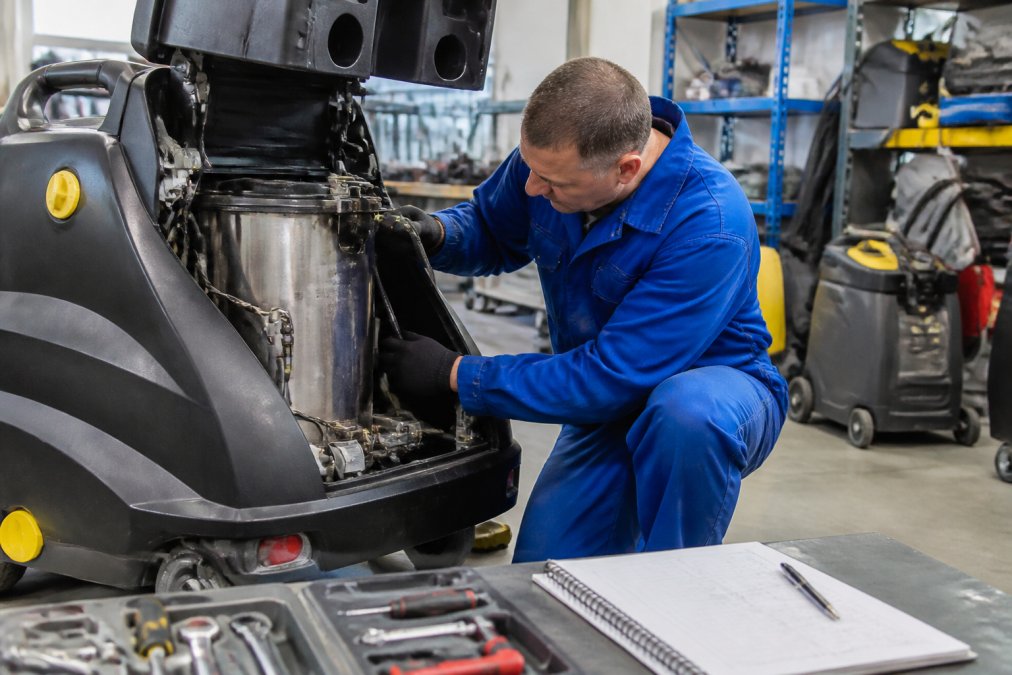
Descaling frequency depends on water hardness. In soft water areas, a self-descaling cycle may be enough on its own. In hard water areas, add a periodic manual check even if the machine self-descales.
Running a boiler dry is the fastest way to destroy it.
Seals and gaskets wear with heat cycling. Replace them at the interval the manufacturer specifies rather than waiting for a leak. A leaking seal during a hospital contract means a failed inspection and a callback visit.
Keep a service logbook. It supports your compliance documentation and helps you spot patterns before they become breakdowns. The NHS guidance on cleaning and decontamination standards is a useful reference for healthcare sites building that paper trail.
Conclusion: Choosing the Right Alternative for Your Operation
Finding a Kärcher commercial steam cleaner alternative that suits your operation means weighing boiler design, duty cycle and descaling protection against your actual working pattern. Brand recognition tells you nothing about whether a machine will survive your water supply.
At Pure Steam Cleaners, we have spent thirty years building equipment for facilities that cannot afford downtime. Our patented self-descaling boiler technology, three-year boiler guarantee and Defra-qualified engineering give you a machine designed to keep running through hard water and heavy use.
Get started with Pure Steam Cleaners and specify the right machine for your site.
Frequently Asked Questions
What are the best professional alternatives to Kärcher steam cleaners?
Alternatives range from other established manufacturers to specialist suppliers focused on commercial and industrial steam equipment. When comparing, look at boiler construction, limescale prevention technology, duty cycle, and after-sales support rather than brand recognition alone. A machine with a self-descaling boiler and a long guarantee may suit hard water areas better than a standard unit. Request references from businesses in your sector before committing.
Is a steam cleaner better than chemical cleaning for hygiene compliance?
Steam cleaning uses high-temperature vapour to kill bacteria and lift grease without leaving chemical residue, which can simplify compliance in food preparation, healthcare, and care home settings. Chemical sanitisers remain effective but require correct dilution, contact time, and rinsing. Many operations use steam as the primary method and chemicals only for specific tasks. Check your sector’s guidance and inspector expectations before switching entirely.
How do I maintain a commercial steam cleaner for longevity?
Empty and rinse the boiler regularly, use filtered or softened water where possible, and follow the manufacturer’s descaling schedule. Check seals, hoses, and nozzles for wear, and store the machine in a dry, frost-free area. Keep a service log so you can spot recurring issues early. A machine with self-descaling technology reduces the frequency of manual descaling but does not remove the need for routine checks.
Can one commercial steam cleaner handle multiple sectors, such as kitchens, hospitals, and factories?
A versatile machine with adjustable pressure, multiple attachments, and a continuous-fill option can cover several environments. However, hygiene-critical areas like hospitals and dental practices may need dedicated equipment or additional validation. Contract cleaners serving diverse clients often carry one main unit plus specialist attachments. Discuss your client mix with the supplier to confirm the machine meets each sector’s requirements.
