
Commercial & Industrial Steam Cleaners | Pure Steam Cleaners.uk


Last Updated: November 7, 2026
Quick Summary
Successful steam cleaner buying in 2026 starts with duty cycle: match the machine to your site’s surfaces, daily steam hours and water hardness before comparing prices. Prioritise continuous steam output, limescale-resistant boiler construction and serviceable parts, then confirm accessories, warranty terms and spare parts lead times before ordering.
- The v6 range runs at 6 bar with 43 g/min of continuous output.
- The i6-SO produces 53 g/min at 6 bar from three 1000-watt elements.
- One machine can serve around 15 varied clients with the right accessories.
- Self-descaling boilers carry a 3-year guarantee and cut limescale downtime.
- Orders before 1.00 pm ship free on a next working day service.
Table of Contents
- What a Professional Steam Cleaner Must Deliver
- Steam Cleaner Features That Decide the Specification
- Your Commercial Steam Cleaner Buying Guide: Matching Machine to Site
- Steam Cleaner Accessories That Earn Their Place on the Van
- Steam Cleaner Maintenance, Hard Water and Whole-Life Costs
- Surface Safety, Sanitising Evidence and Professional-Use Rules
- Choosing Your Pure Steam Machine and Ordering Online
- Frequently Asked Questions
What a Professional Steam Cleaner Must Deliver
A professional steam cleaner is a commercial-grade machine that generates dry steam at controlled pressure for continuous cleaning and sanitising across large sites. Unlike light domestic units, it must run for hours, hold pressure under load, and survive hard water without frequent descaling.
This professional steam cleaner buying guide in 2026 starts with one principle: duty cycle decides everything. A machine that suits a small café will fail in a food processing plant running two shifts.
Three specifications separate professional machines from everything else:
- Continuous steam output, not a burst rating on a box
- Boiler construction that resists limescale in hard water areas
- Serviceable parts so a breakdown does not mean a write-off
Get those right and the rest of the specification falls into place.
Steam Cleaner Features That Decide the Specification
The features that decide which professional machine you buy are pressure, steam output, heat-up time, tank capacity, refill design, cord length and format. Everything else, from handle shape to colour, is preference.
Pressure, Steam Output and Heat-Up Time
Pressure and output are different measurements and buyers confuse them constantly. Pressure, quoted in bar, describes the force behind the steam. Output, quoted in grams per minute, describes how much steam reaches the surface.
The v6 range runs at 6 bar with 43 g/min of continuous output. The i6-SO produces 53 g/min at the same pressure. For heavy grease and production-line work, output matters most. For detail work in tight areas, pressure does more of the work. Health and Safety Executive guidance on pressure systems is worth reading if your site operates any pressure equipment.
Heat-up time affects your scheduling. Operators lose paid time waiting for steam, so check the figure before you commit. A machine that takes several minutes to reach working pressure is fine for a single scheduled deep clean but costly where an operative moves between short jobs.
Continuous output is the figure that matters commercially. A burst rating on a box tells you what the boiler can do for a moment; continuous output tells you what it delivers across an hour.
Tank Capacity, Continuous Refill and Cord Length
Tank capacity sets how long an operator works between refills. A 5-litre container, as on the i6-SO, gives continuous running time and hot water on request. Compact v6 models use 3 litres of water plus, on detergent versions, 3 litres of detergent.
Continuous refill changes the calculation. Machines that let you top up without shutting down keep the operative on the floor rather than at the tap.
Cord length and hose reach decide how far one machine travels from a socket. Measure your longest run before ordering, and remember that a trolley-mounted unit moves with the operator rather than being carried.
Format: Handheld, Mop and Cylinder Designs
Format follows the work. Handheld units suit detail cleaning, upholstery and tight access. Mop-style units suit large sealed floor areas where the operator walks the machine. Cylinder and trolley designs carry larger boilers and accessory kits, which is why they dominate contract cleaning and food production. The format decision should be made after the surface list and daily steam hours are known, not before.
Your Commercial Steam Cleaner Buying Guide: Matching Machine to Site
The right machine for a contract cleaner is not the right machine for a care home, and a commercial steam cleaner buying guide that ignores this is useless. Match on three questions: what surfaces, how many hours, and who operates it.
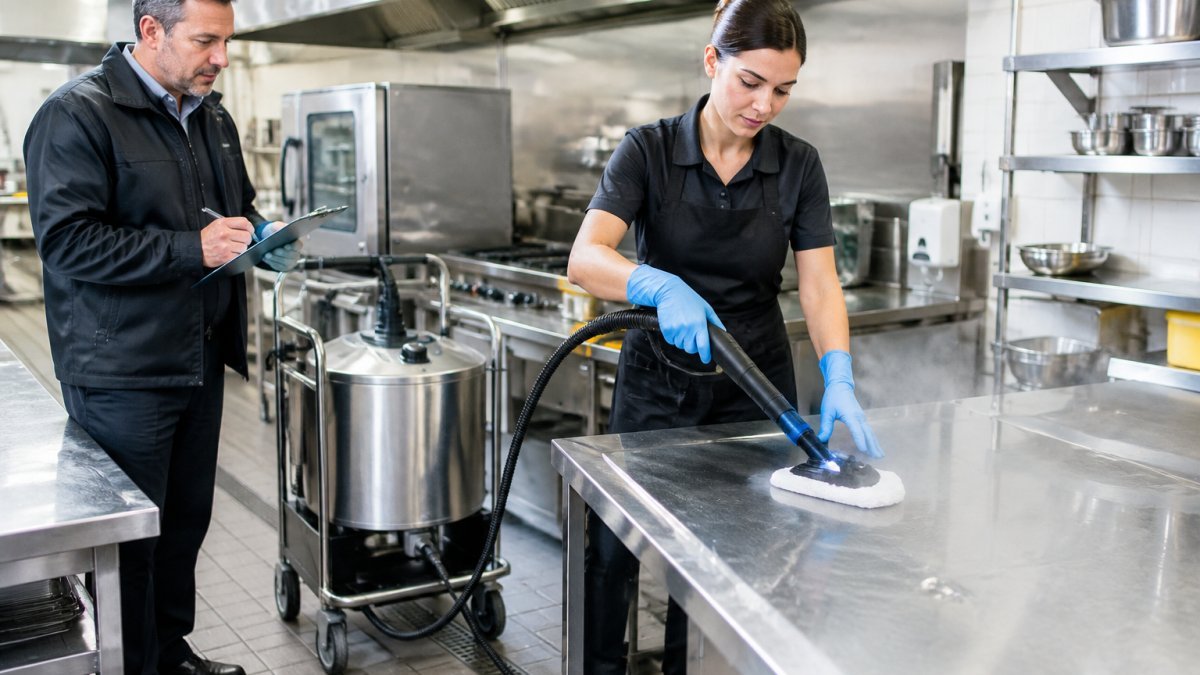
Work through the shortlist in this order:
- List every surface type on site, including grout, stainless steel and upholstery
- Estimate daily steam hours per machine
- Confirm the site’s water hardness with the supplier
- Check whether detergent injection is needed for grease or gum
- Confirm accessory availability for each surface
- Verify after-sales support and spare parts lead times
| Site type | Priority feature | Machine type |
|---|---|---|
| Commercial kitchen | High output, detergent injection | Trolley steam and vacuum |
| Care home or hospital | Continuous output, quiet operation | Compact steam and vacuum |
| Food processing | Heavy-duty output, strong boiler | Industrial cylinder |
| Contract cleaning | Versatility, accessory range | Steam and vacuum with detergent |
| Automotive workshop | Pressure for degreasing | Industrial with jet tools |
One machine can serve around 15 varied clients if it carries the right accessories and enough output. Where sites demand simultaneous steam and extraction, a combined unit saves a second pass.
Steam Cleaner Accessories That Earn Their Place on the Van
Accessories decide how many jobs one machine covers, so treat the tool kit as part of the specification. A floor head and microfibre pad handle hard floors. A brush attachment works grout and tile lines.
Upholstery tools matter where soft furnishings are cleaned on site. Detergent injection helps on chewing gum and heavy grease, where steam alone needs longer dwell time.
Watch out: buying a machine with a narrow accessory range locks you into one or two surface types. Check the full tool list before ordering, and ask whether tools are available individually later.
You can browse the full steam and vacuum tools and accessories range to see what ships with each machine.
Steam Cleaner Maintenance, Hard Water and Whole-Life Costs
Steam cleaner maintenance comes down to water. Hard water leaves limescale in the boiler, and limescale reduces output, raises heat-up time and eventually ends the machine’s life. This is the single largest whole-life cost most buyers underestimate.
Self-descaling boiler technology changes that calculation. Our patented self-descaling boiler technology is designed to clear scale as part of normal operation, and boilers carry a 3-year guarantee.
Watch out: skipping regular boiler care in a hard water area will shorten machine life regardless of build quality. Follow the operating instructions for your model.
Two pages explain this in more depth: why self-descaling matters in commercial steam cleaners, and the signs your steam cleaner has limescale so you can catch it early.
| Cost area | What drives it | How to control it |
|---|---|---|
| Descaling and downtime | Water hardness | Self-descaling boiler |
| Chemical spend | Reliance on detergents | Steam-first process |
| Repairs | Scale and element wear | Regular boiler care |
| Replacement | Machine lifespan | Correct specification upfront |
Surface Safety, Sanitising Evidence and Professional-Use Rules
Surface safety is where most buying mistakes surface later. Sealed hard floors, stainless steel, tiles and grout take steam well. Unsealed wood, some laminates and certain fabrics do not, and manufacturer guidance should decide the tool and temperature you use on each.
A practical surface check works in three steps. First, confirm the surface is sealed and the seal is intact. Second, test a small hidden area with the tool and temperature you intend to use, then inspect after it has dried. Third, record the result so the same decision is not remade by every operative.
Sanitising claims deserve scrutiny. Steam cleaning is a chemical-free process that uses heat and moisture to remove grease, soil and contaminants.
Professional-use requirements vary by sector. Care homes and healthcare settings have hygiene policies that determine what equipment and process are acceptable, and inspectors will ask for documentation. Care Quality Commission guidance for providers sets out the regulatory context providers work within. Food businesses operate under food safety and hygiene regulations, and the Food Standards Agency hygiene guidance explains what those require in practice.
Commercial suitability goes beyond headline specifications.
The business is Defra qualified and has 30 years of experience. Savings from steam cleaning come from chemical spend, downtime and machine life rather than from the purchase price.
Choosing Your Pure Steam Machine and Ordering Online
Choosing your machine comes down to output, format and accessories. Here is how we would shortlist our own range for a professional steam cleaner buying guide in 2026.
Pure i6-SO Industrial Professional Steam Cleaner, £1,995.00. Three 1000-watt elements produce 53 g/min at 6 bar through a standard UK plug, fed by a 5-litre container with hot water on request and a 5-litre detergent bottle for gum and grease work. Best for food processing, industrial kitchens and heavy-duty sites. Skip if you need vacuum extraction in the same pass.
Pure v6-DT Commercial Steam Cleaner with Vacuum and Detergent, £1,745.00. 6 bar and 43 g/min with continuous output, 3 litres of water plus 3 litres of detergent, and switchable detergent injection. Best for contract cleaners covering varied clients. Skip if your sites never need detergent.
Pure v6-T Commercial Steam and Vacuum Cleaner, £1,595.00. The same 6 bar and 43 g/min with vacuum and trolley, without detergent injection. Best for healthcare, hospitality and retail where steam and extraction cover the work.
Pure v6 Commercial Steam Vacuum Cleaner, £1,495.00. Compact steam and vacuum for windows, hoods, hard floors, bathroom fittings and tiles. Best for smaller catering operations and tighter budgets.
Orders placed before 1.00 pm ship free on a next working day service. Compare the full range of commercial steam cleaners, and read why consistent steam output matters before you finalise output requirements.
Matching a machine to your site is the decision that determines reliability, running costs and how long the equipment lasts.
Frequently Asked Questions
What should I look for in a professional steam cleaner?
Start with pressure and steam output, because they decide how quickly grease and soil lift: 6 bar and around 43 to 53 g/min of continuous steam covers most commercial work. Then check boiler construction, tank capacity, cord length and whether a vacuum or detergent injection is included. Whole-life factors matter as much as the headline spec, so confirm descaling guidance for hard-water areas and what the boiler guarantee actually covers before you commit.
How much steam pressure does a professional steam cleaner need?
For commercial kitchens, care homes and food production, 6 bar is the practical benchmark. It is enough to shift baked-on grease and contamination without damaging sealed surfaces, and it is the pressure the Pure i6-SO and v6 range run at. Lower pressures suit light duty but slow you down on heavy soil. Higher figures are not automatically better; consistent continuous steam output matters more than a peak reading.
Which steam cleaner accessories are useful for commercial steam cleaning?
The floor head and microfibre pads handle hard floors and grout, while brush attachments reach into corners, hinges and machinery housings. A window tool keeps glass and display cases streak-free, and a jet nozzle concentrates steam on grease traps and tile lines. Upholstery tools are worth having for chairs and soft furnishings. Match the accessory set to your client mix so one machine covers kitchens, bathrooms and vehicles.
How do I maintain a professional steam cleaner in a hard water area?
Descale on the schedule in your operating manual rather than waiting for performance to drop. Hard water scales boilers quickly, and scale is the most common cause of premature failure in commercial machines. Pure Steam’s patented self-descaling boiler technology is designed to reduce limescale build-up, and the copper boilers use external heating elements that do not sit in the water. Keep records of descaling for inspection and warranty purposes.
Can one commercial steam cleaner handle hospitals, kitchens and factories?
A versatile machine with continuous steam, a vacuum and detergent injection can cover a mixed contract portfolio, but check tank size and mobility against each site. The Pure v6-DT, for example, combines 6 bar pressure, 43 g/min steam, a 3-litre water tank and 3 litres of detergent, which suits healthcare, hospitality and food retail work. Very heavy industrial degreasing may still justify the higher-output i6-SO alongside it.
How long before a professional steam cleaner pays for itself?
Payback depends on how much you currently spend on chemicals, labour time and downtime. Steam cleaning uses very little water and no harsh chemicals, so the savings build across consumables and reduced chemical handling. Ask for a cost comparison based on your own chemical spend before you buy.

