
Commercial & Industrial Steam Cleaners | Pure Steam Cleaners.uk


Table of Contents
- How Steam Cleaner and Chemical Cleaning Costs Compare
- Steam Cleaning Benefits for Commercial Kitchens
- COSHH Compliance and Steam Cleaning
- Industrial Steam Cleaner ROI: When Does It Pay Back?
- Hidden Costs of Chemical Cleaning
- How to Choose the Right Steam Cleaner for Your Business
- Frequently Asked Questions
Last Updated: September 27, 2026
How Steam Cleaner and Chemical Cleaning Costs Compare
Steam cleaner vs chemical cleaning costs is a comparison that most facility managers get wrong, because they only count what they hand over at the till. The true cost of chemical cleaning includes the chemicals, the protective equipment, the training, the storage, the disposal, and the staff time spent mixing and rinsing. Steam cleaning front-loads the cost into one machine, then runs on water and electricity.
At Pure Steam Cleaners, we have supplied machines to commercial kitchens, care homes, food plants and contract cleaning firms for three decades. The pattern is consistent: chemical budgets look cheap month to month and expensive year to year.
Below, we break down both sides of the ledger, from upfront equipment to the hidden costs that rarely appear in a cleaning budget, so you can judge payback for your own site.
Upfront Equipment and Consumable Costs
A commercial steam cleaner is a capital purchase. You buy the machine once, and the running cost afterwards is largely water, electricity and occasional servicing. A chemical programme has almost no upfront equipment cost, but you buy chemicals every month, forever.
That difference matters most in year one, when the steam machine is at its most expensive and the chemical cupboard still looks economical. From year two onwards, the picture flips. Pricing for commercial steam cleaners depends on boiler size, pressure, tank capacity and the duty cycle you need, so we quote per site rather than publish a flat figure. Check current pricing on our product pages or request a quote.
Ongoing Operational Costs
Ongoing costs split into four buckets: consumables, labour, downtime and waste. Chemical cleaning spends on all four. Steam cleaning spends mainly on labour and electricity.
- Consumables: chemicals, dilution equipment, cloths and mops versus water and electricity
- Labour: mixing, dwell time, rinsing and PPE changes versus a single steam pass
- Downtime: waiting for surfaces to dry or be re-rinsed versus near-instant dry
- Waste: chemical disposal and expired stock versus no chemical waste stream
| Cost Factor | Chemical Cleaning | Steam Cleaning |
|---|---|---|
| Upfront equipment | Low | One-off machine cost |
| Monthly consumables | Ongoing chemical spend | Water and electricity |
| Labour per task | Mixing, dwell, rinse | Single pass |
| Drying time | Minutes to hours | Near-instant |
| Waste disposal | Chemical waste stream | None |
| Training burden | COSHH and PPE training | Operator training only |
The cost advantage of steam cleaning is not the machine price. It is the removal of a permanent chemical line item from your operating budget.
Steam Cleaning Benefits for Commercial Kitchens
Steam cleaning benefits for commercial kitchens come down to three things: grease removal without chemicals, faster turnaround between services, and no residue left on food-contact surfaces. A commercial kitchen is the hardest test for any cleaning method, because grease bakes onto stainless steel, extraction hoods and floor gullies every single day.
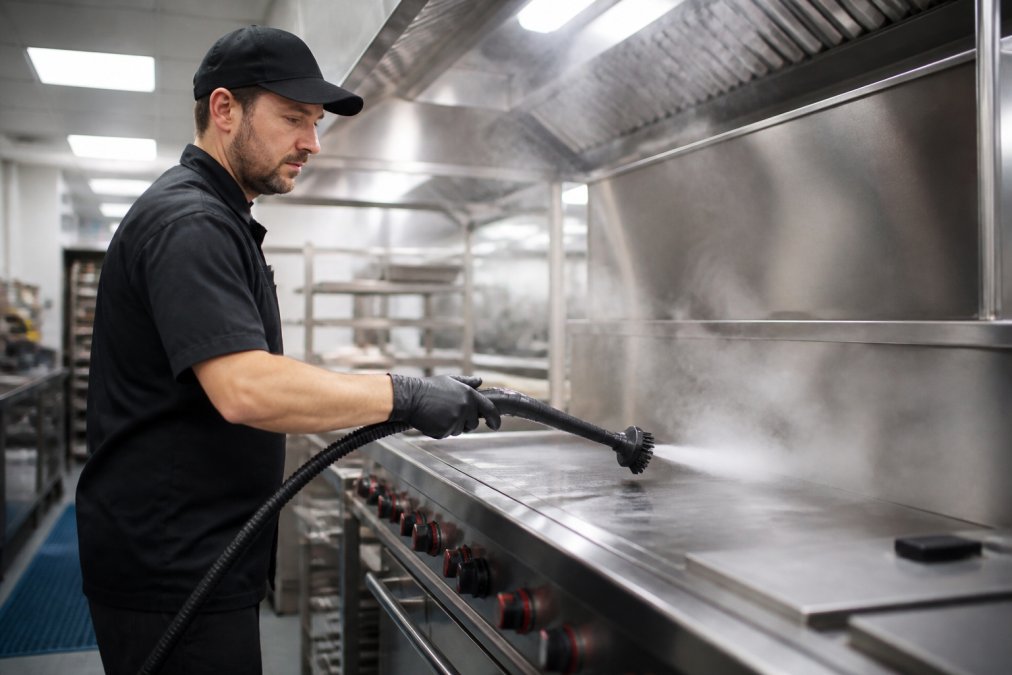
Chemical degreasers work, but they need dwell time, correct dilution, rinsing and often a second pass. Steam does the same job in one pass, and the surface is dry almost immediately. For a kitchen running multiple services a day, that time saving is the real return.
COSHH Compliance and Steam Cleaning
COSHH compliance and steam cleaning fit together neatly, because the Control of Substances Hazardous to Health Regulations require employers to assess and control exposure to hazardous substances (Control of substances hazardous to health (COSHH)). The simplest control is elimination: if you remove the hazardous substance from the process, there is nothing left to assess, store or dispose of.
That is the argument for steam in regulated environments. Care homes, hospitals and food processing sites all operate under strict hygiene expectations, and inspectors want to see that you have either controlled a chemical risk or removed it. Steam removes it. According to HSE guidance on COSHH, employers must prevent or adequately control exposure to hazardous substances, and elimination sits at the top of the hierarchy of control.
Switching to steam does not remove your COSHH duties entirely. You still need risk assessments for the machine, hot surfaces and any residual chemicals used elsewhere on site.
Industrial Steam Cleaner ROI: When Does It Pay Back?
Industrial steam cleaner ROI depends on how much you currently spend on chemicals, labour and downtime. The payback calculation is simple: add up your annual chemical spend, the labour hours spent mixing and rinsing, and the cost of downtime waiting for surfaces to dry. Compare that total to the machine cost plus its annual running costs.
For most sites, payback arrives within the first year or two, and every year after that is pure saving. A contract cleaning business running fifteen clients across hospitals, kitchens and factories is the clearest case: one machine replaces a van full of chemicals and covers every job type.
Hidden Costs of Chemical Cleaning
The hidden costs of chemical cleaning rarely appear on a purchase order. They sit in training hours, PPE, storage compliance, disposal fees and staff turnover when people get tired of working with harsh substances.
- Training: COSHH assessments, safe handling and PPE training for every new starter
- Storage: locked cabinets, ventilation and stock rotation to avoid expired chemicals
- Disposal: safe disposal of unused or expired chemicals, which carries its own cost
- Health: skin and respiratory irritation that drives sickness absence
- Reordering: the admin time spent tracking stock and reordering
None of these are dramatic on their own. Together, they add up to a permanent overhead that steam cleaning simply does not carry.
How to Choose the Right Steam Cleaner for Your Business
Choosing the right machine starts with three questions: what are you cleaning, how often, and in what environment? A small catering business needs a different machine from a food processing plant running continuous shifts.
Look for a boiler built to handle your water supply. In hard water areas, limescale is the single biggest cause of breakdowns, and a machine without proper scale control will fail early. Pure Steam Cleaners builds patented self-descaling boiler technology into its machines, backed by a 3-year boiler guarantee, which matters if your last unit kept failing on limescale.
- Duty cycle: occasional use versus continuous shifts
- Boiler size: matched to the volume of cleaning per session
- Mobility: portable units for multi-site contract cleaners
- Water quality: scale control for hard water areas
- Support: how quickly you can get back up and running
Ask any supplier what happens when the machine fails during a busy service period. The answer tells you more about the machine than the spec sheet does.
Chemical cleaning will always look cheaper on the first invoice. It is the second, third and fourth invoice that tell the real story, once training, storage, disposal and downtime are counted. Pure Steam Cleaners has spent thirty years supplying machines that remove those costs entirely, with patented self-descaling boiler technology, a 3-year boiler guarantee, and free next working day delivery on orders placed before 1pm. Get started with Pure Steam Cleaners and see how quickly the machine pays for itself.
Frequently Asked Questions
Is steam cleaning more cost-effective than chemical cleaning for businesses?
Steam cleaning typically costs less over time because it uses only water and electricity. Chemical cleaning requires ongoing purchases of detergents, sanitisers and protective equipment. Steam also reduces labour time since one pass cleans and sanitises. The exact saving depends on your cleaning frequency, facility size and current chemical spend, but most businesses see a return on investment within 12 to 18 months.
Does steam cleaning reduce the need for expensive cleaning consumables?
Yes. Steam cleaning eliminates most chemical consumables, including degreasers, sanitisers, rinsing agents and disposable cloths. You still need microfibre cloths and water, but the recurring cost drops significantly. For commercial kitchens, this can mean hundreds of pounds saved each month on chemical supplies alone, plus reduced storage space and less time ordering and managing stock.
Is steam cleaning compliant with UK health and safety hygiene standards?
Steam cleaning supports compliance with UK hygiene regulations, including COSHH and food safety requirements. Because steam reaches high temperatures, it kills bacteria without leaving chemical residue. This makes it suitable for food preparation areas, healthcare settings and care homes where chemical residues are a concern. Always follow your equipment manufacturer’s guidance and document your cleaning procedures for inspectors.
How does steam cleaning impact labour costs compared to chemical methods?
Steam cleaning often reduces labour costs because it combines cleaning and sanitising in one step. Staff spend less time applying chemicals, waiting for dwell times and rinsing surfaces. In commercial kitchens and food processing plants, this can cut cleaning time by 30 to 50 percent. Faster turnaround means your team can focus on other tasks, which improves overall operational efficiency.
